
What Makes an Effective Surveillance System for Perimeter Security?
Security technologies have evolved dramatically over the last decade. While traditional surveillance systems focused primarily on recording events, today's security professionals require solutions capable of detecting threats early, improving situational awareness, and providing actionable intelligence before incidents occur.
As organizations face increasing security challenges, many are asking an important question:
What makes an effective surveillance system?
The answer goes beyond image quality or the number of cameras deployed. An effective surveillance system must provide reliable detection, meaningful intelligence, and the ability to help security personnel respond before a threat reaches critical assets.

Detection Is the Foundation of Effective Surveillance
The primary purpose of surveillance is not simply to record what happened.
The most effective surveillance systems help organizations identify threats before an incident occurs.
Early detection creates valuable response time, allowing security personnel to assess the situation, verify the activity, and initiate an appropriate response.
Whether protecting a data center, power generation facility, airport, correctional facility, or industrial operation, the ability to detect threats early remains one of the most important elements of perimeter security.
Why Traditional Surveillance Has Limitations
Conventional surveillance systems often rely on large numbers of fixed cameras positioned throughout a facility.
While these systems provide visual coverage, they can present challenges such as:
Large camera counts
Significant infrastructure requirements
Licensing costs
Maintenance expenses
Increased operator workload
In many environments, security personnel are required to monitor multiple camera feeds simultaneously, making it difficult to identify threats quickly across large outdoor areas.
As facilities grow, these challenges become even more pronounced.
Continuous Monitoring Improves Situational Awareness
An effective surveillance system should provide continuous awareness of the entire protected area.
Continuous monitoring helps eliminate blind spots and reduces the likelihood that suspicious activity goes unnoticed.
This is particularly important for large facilities such as:
Data centers
Electrical substations
Power generation facilities
Airports
Ports and maritime facilities
Mining operations
Oil and gas sites
Critical infrastructure
In these environments, comprehensive situational awareness is essential for maintaining security and operational continuity.
The Role of Thermal Detection
Thermal detection has become one of the most valuable technologies in modern perimeter security.
Unlike conventional cameras that rely on visible light, thermal systems identify heat signatures emitted by people, vehicles, and equipment.
This allows security personnel to detect activity during:
Daylight
Complete darkness
Low-light conditions
Challenging outdoor environments
Thermal detection serves as an effective first layer of security by identifying potential threats regardless of lighting conditions.
Intelligent Analytics Deliver Actionable Information
Modern surveillance systems generate large amounts of data.
Without intelligent analytics, operators can quickly become overwhelmed by the volume of information being presented.
Advanced analytics help identify:
Human activity
Vehicle movement
Unauthorized perimeter crossings
Potential fire events
Areas requiring immediate attention
These capabilities help reduce nuisance alarms while ensuring security personnel focus on events that matter most.
Why 360° Monitoring Matters for an Effective Surveillance System
Many traditional surveillance systems are limited by fixed fields of view.
As a result, organizations often deploy numerous cameras to achieve complete coverage.
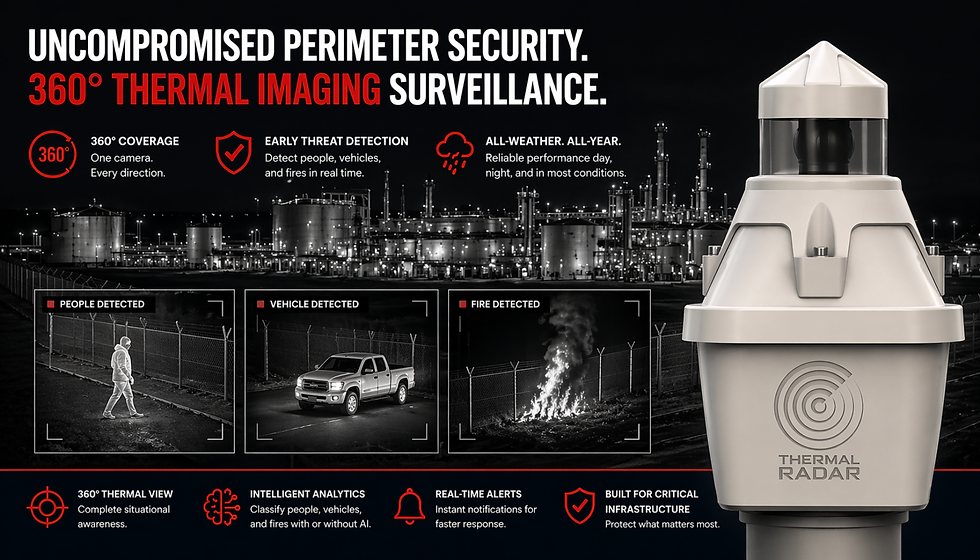
A continuous 360° monitoring approach offers significant advantages by providing awareness across the entire protected area, often from a single detection platform.
This can help organizations:
Reduce camera counts
Lower infrastructure requirements
Simplify system design
Improve coverage
Reduce the total cost of ownership
The result is a more efficient and scalable surveillance solution.
Building a More Effective Surveillance System Strategy
The most effective surveillance systems combine multiple technologies into a unified security strategy.
Detection, analytics, verification, and response all play important roles in protecting critical assets.
Organizations that invest in modern surveillance technologies can improve security performance while reducing complexity and operating costs.
By combining continuous monitoring, thermal detection, intelligent analytics, and automated alerting, security teams gain the information they need to make faster and more informed decisions.
About Thermal Radar™
Thermal Radar™ is a patented 360° thermal detection platform designed to provide wide-area perimeter security, intrusion detection, and early fire detection across large outdoor environments. Built and manufactured in the United States, Thermal Radar™ continuously scans a full 360° area and provides actionable alerts on human, vehicle, and fire events. Thermal Radar™ helps organizations reduce camera counts, lower infrastructure costs, and improve situational awareness through intelligent analytics, automated visual verification, and seamless integration with leading VMS, PSIM, and PTZ camera platforms.
Learn More: https://www.thermalradar.com/thermal-radar


Comments