
Thermal Camera Deployment for Perimeter Security: Best Practices for Reliable Detection and Wide-Area Coverage

Thermal imaging has become one of the most important technologies in modern perimeter security. Unlike visible-light cameras, thermal systems detect heat signatures, allowing security teams to monitor outdoor environments regardless of lighting conditions and often through environmental obscurants that challenge traditional video surveillance.
However, achieving reliable performance requires more than simply installing thermal cameras around a perimeter. Successful thermal camera deployment for perimeter security depends on careful planning, proper system design, realistic detection expectations, and selecting technologies that align with operational objectives.
Whether protecting a solar farm, electrical substation, data center, airport, port facility, utility site, warehouse complex, mining operation, or critical infrastructure asset, understanding the fundamentals of thermal deployment can significantly improve security outcomes.
Why Thermal Imaging Plays a Critical Role in Perimeter Security
Traditional surveillance systems rely heavily on visible light. As a result, performance can degrade at night or when environmental conditions reduce visibility.
Thermal imaging operates differently.
Rather than capturing reflected light, thermal cameras detect temperature differences and heat signatures. This allows security operators to identify people, vehicles, equipment, and developing fire events based on thermal contrast.
Benefits often include:
24/7 monitoring capabilities
Improved nighttime detection
Detection in low-light environments
Enhanced situational awareness across large outdoor areas
Reduced dependence on supplemental lighting
Support for intrusion detection and developing fire event detection
Improved monitoring of remote or unmanned facilities
These advantages explain why thermal surveillance technologies are increasingly deployed across critical infrastructure and industrial environments worldwide.
Defining Objectives Before Deployment
One of the most common mistakes in perimeter security design is selecting equipment before defining operational requirements.
Before choosing cameras, lenses, towers, or software, organizations should establish:
What needs to be protected?
What threats are most likely?
How early must detection occur?
What level of verification is required?
How large is the area being monitored?
What environmental conditions exist?
Will the system support security, fire detection, or both?
Answering these questions helps determine whether a deployment should prioritize:
Long-range detection
Wide-area coverage
Intrusion classification
Automated tracking
Fire detection capabilities
Multi-sensor integration
Mobile or fixed deployments
The most effective systems are designed around operational goals rather than hardware specifications alone.
Thermal Camera Deployment for Perimeter Security Requires Strategic Placement
Camera placement remains one of the most important factors influencing system performance.
Many conventional deployments position fixed thermal cameras along perimeter boundaries. While this approach can be effective, it often requires multiple devices, overlapping coverage zones, communication infrastructure, and careful alignment.
When deploying thermal cameras, security professionals typically evaluate:
Viewing Angles
Targets are generally easier to detect when moving across a sensor's field of view rather than directly toward it.
Proper placement helps maximize thermal contrast and target visibility while improving analytics performance.
Mounting Height
Higher mounting positions can extend coverage areas while reducing obstacles that may block line of sight.
However, excessive height can also reduce target detail and impact classification performance.
The optimal height depends on:
Site layout
Terrain conditions
Detection objectives
Sensor specifications
Blind Spot Reduction
Every surveillance system has potential blind spots.
Designers should identify:
Terrain changes
Buildings
Equipment yards
Vegetation
Storage areas
Infrastructure obstructions
Coverage planning should account for these variables to minimize undetected approaches.
Detection Performance Matters More Than Maximum Range
Many organizations evaluate thermal systems primarily by maximum detection range.
While range is important, it should not be the only consideration.
A more useful question is:
How reliably can the system detect a target throughout the entire protected area?
Effective deployment requires balancing:
Detection range
Coverage area
Field of view
Target size
Environmental conditions
Analytics performance
A camera capable of detecting a target several miles away may not necessarily provide the optimal coverage strategy for a large operational environment.
The goal should always be dependable detection performance across the entire area of interest.
Coverage Planning and Area Awareness
Large facilities often face challenges that extend beyond traditional perimeter boundaries.
Modern security programs increasingly require visibility into:
Exterior approach areas
Fence lines
Internal operational zones
High-value assets
Remote infrastructure
Vehicle movement corridors
This has led many organizations to move beyond simple perimeter monitoring toward broader situational awareness strategies.
Rather than focusing solely on boundary protection, advanced thermal surveillance deployments often support:
Early threat detection
Inside-out monitoring
Multi-zone alerting
Geospatial awareness
Activity assessment across wide areas
These capabilities help security teams identify potential threats earlier and respond more effectively.
Selecting the Right Focal Length for Thermal Perimeter Security
One of the most important, and frequently misunderstood, aspects of thermal camera deployment is lens selection.
The focal length of a thermal camera directly influences how much of an area can be monitored and how much detail can be captured within that area. Selecting the wrong lens can result in coverage gaps, reduced detection performance, excessive infrastructure requirements, or unnecessary system costs.
How Focal Length Impacts Thermal Surveillance
In general:
Longer focal length lenses provide greater distance and narrower fields of view.
Shorter focal length lenses provide wider fields of view and broader area coverage.

A longer focal length allows a thermal camera to detect targets at greater distances. However, because the field of view is narrower, additional cameras may be required to cover larger areas. Additionally, object classification becomes increasingly difficult at longer distances because targets occupy fewer pixels on target in the thermal image. While the system may still reliably detect activity, distinguishing whether the target is a person, vehicle, animal, or other object becomes more challenging as pixel density decreases.
Conversely, a shorter focal length enables a camera to monitor a wider area with a single device, but individual targets occupy more pixels within the image, which can improve detection, classification, or identification performance, but within shorter distances.
The optimal lens selection depends on the operational objectives of the deployment.
Detection vs. Classification vs. Identification
Security professionals often evaluate thermal systems based on three performance categories:
Detection
Detection answers a simple question: "Is something there?"
At this stage, the system recognizes the presence of a heat-emitting object within the scene.
Classification
Classification answers: "What type of object is it?"
For example, the system may distinguish between:
A human
A vehicle
An animal
Equipment generating heat
Identification
Identification attempts to answer: "Exactly who or what is it?"
This level of detail requires additional sensors, visible-light cameras, PTZ cameras, or closer observation.
Many perimeter security deployments prioritize reliable detection and rapid assessment rather than identification alone.
Coverage Requirements Should Drive Lens Selection
A common mistake is selecting the longest available lens simply because it provides the greatest range.
In reality, security designers should first determine:
The area requiring protection
The required detection distance
The desired response time
The acceptable level of infrastructure investment
The operational workflow for alarm assessment
The goal is typically to define the minimum scene width necessary to monitor the protected area and then select a lens that provides the best balance between coverage and detection performance.
This approach often results in more efficient deployments and better long-term operational performance.
Why Wide-Area Awareness Is Becoming More Important
Historically, many thermal deployments focused on monitoring a narrow perimeter corridor using multiple fixed cameras equipped with carefully selected lenses.
Today, organizations increasingly seek broader situational awareness across entire facilities rather than simply observing fence lines.
This shift is driving interest in technologies that can monitor large outdoor environments without requiring extensive networks of overlapping fixed thermal cameras.
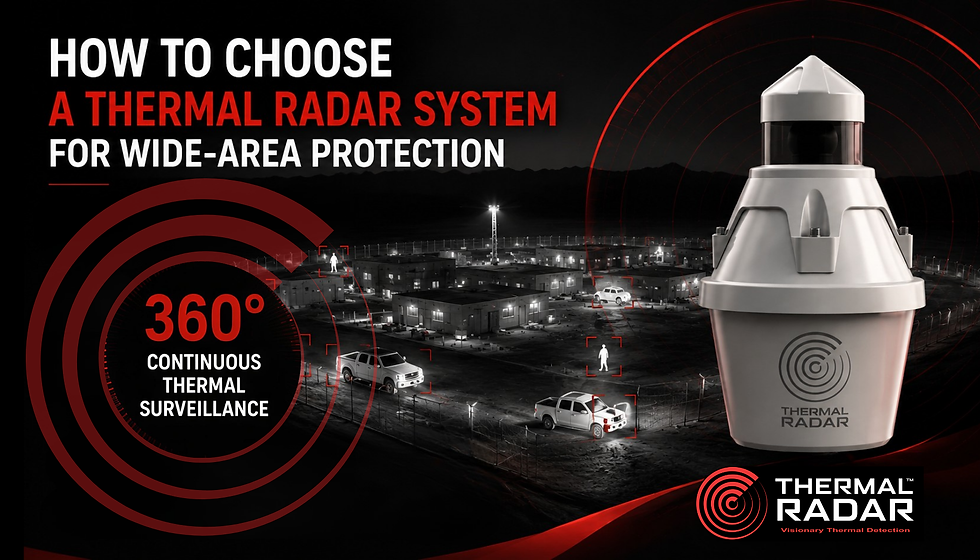
For example, Thermal Radar™ utilizes patented rotating thermal surveillance technology to continuously monitor a 360-degree environment from a single location. Rather than relying solely on fixed fields of view and individual lens optimization, Thermal Radar™ helps security teams maintain awareness across large operational areas while supporting human, vehicle, and developing fire event detection.
For many organizations, the discussion is evolving from selecting the perfect lens for a single camera to determining how best to achieve complete site awareness with the fewest blind spots and infrastructure requirements.
Analytics Are Just as Important as the Camera
A thermal sensor alone does not create a complete security solution.
Modern thermal surveillance increasingly depends on intelligent analytics that help operators distinguish meaningful events from background activity.
Analytics can assist with:
Human detection
Vehicle detection
Target classification
Direction-of-travel assessment
Zone-based alerting
Fire detection
Alarm prioritization
The effectiveness of any deployment often depends on how well analytics are configured and calibrated for the operational environment.
A properly tuned analytics platform can significantly reduce nuisance alarms while improving operator efficiency.
Infrastructure and Power Considerations
Infrastructure planning is frequently overlooked during thermal camera deployment.
In many cases, the cost of supporting infrastructure exceeds the cost of the cameras themselves.
Organizations should evaluate:
Power Availability
Questions include:
Is utility power available?
Are solar-powered deployments required?
Are backup systems necessary?
How much autonomy is required?
Communications
Deployment plans should consider:
Fiber networks
Wireless bridges
LTE connectivity
Network redundancy
Cybersecurity requirements
Environmental Conditions
Outdoor security systems must often operate in:
Extreme heat
Freezing temperatures
Wind
Dust
Rain
Snow
Coastal environments
System reliability depends heavily on designing for local conditions.
Integrating Thermal Detection with Other Security Technologies
Thermal detection is often most effective when integrated into a broader security ecosystem.
Organizations frequently combine thermal surveillance with:
PTZ cameras
Visible-light cameras
Video management systems
Access control platforms
Alarm monitoring systems
Security operations centers
This layered approach allows operators to move quickly from detection to verification and response.
For example, a thermal detection event may automatically direct a PTZ camera toward an area of interest, allowing personnel to visually assess the situation in real time.
The objective is not simply generating alarms, but creating actionable situational awareness.
How Thermal Radar™ Approaches Thermal Camera Deployment for Perimeter Security

Traditional thermal deployments often rely on multiple fixed cameras positioned around a site.
Thermal Radar™ takes a different approach.
Instead of requiring numerous overlapping fixed thermal cameras, Thermal Radar™ uses patented rotating thermal surveillance technology that continuously monitors a 360-degree environment from a single location.

This architecture can help organizations:
Monitor large outdoor areas with fewer devices
Reduce infrastructure requirements
Eliminate many traditional blind spots
Support inside-out monitoring strategies
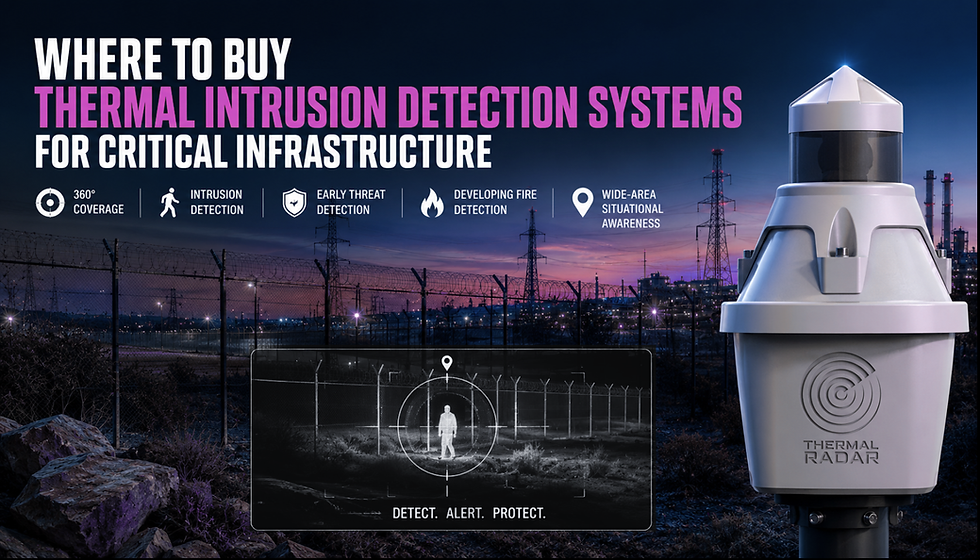
Detect humans, vehicles, and developing fire events
Improve situational awareness across wide operational environments
Thermal Radar™ can function as a standalone thermal detection platform or integrate with PTZ cameras through Hydra™ to support automated visual assessment workflows.
For many organizations, this approach offers an alternative to conventional perimeter-focused thermal deployments by expanding awareness beyond a single fence line.
Future Trends in Thermal Security Deployment
The future of thermal surveillance is moving toward broader operational awareness rather than isolated camera coverage.
Emerging trends include:
AI-assisted detection and classification
Geospatial security visualization
Automated sensor cueing
Multi-sensor fusion
Remote operations management
Wide-area thermal surveillance
Integrated intrusion and fire detection
As security environments become more complex, organizations increasingly seek solutions that deliver meaningful operational intelligence rather than simply additional cameras.
About Thermal Radar™
Thermal Radar™ is a U.S.-based developer and manufacturer of patented thermal surveillance technologies designed to help organizations detect, assess, and respond to activity across large outdoor environments. Unlike traditional fixed-camera approaches, Thermal Radar™ utilizes patented rotating thermal surveillance technology to provide continuous 360-degree situational awareness from a single location, helping security teams monitor beyond the perimeter, at the perimeter, and within protected areas.
Trusted across critical infrastructure, utilities, energy, data centers, transportation, industrial facilities, and other high-security environments, Thermal Radar™ supports human, vehicle, and developing fire event detection while helping organizations reduce blind spots, simplify infrastructure requirements, and improve operational awareness.
Thermal Radar™ solutions can operate as standalone thermal detection platforms or integrate with PTZ cameras, video management systems, and other security technologies to support comprehensive perimeter security strategies worldwide.
Conclusion
Successful thermal camera deployment for perimeter security is about far more than selecting a high-performance thermal camera. Even the most advanced thermal surveillance technology can underperform if it is deployed without careful consideration of coverage requirements, detection objectives, focal length selection, mounting strategies, analytics configuration, and site-specific environmental conditions.
Effective perimeter security begins with understanding what needs to be protected and designing a system that provides reliable visibility across the areas that matter most. Camera placement, coverage overlap, line-of-sight considerations, infrastructure planning, and operational workflows all play critical roles in determining real-world performance.
The goal is not simply to install cameras; it is to create a security architecture that consistently detects, assesses, and supports response to potential threats, day and night, across the entire operational environment.
As security requirements continue to evolve, organizations are increasingly looking beyond traditional fixed-camera deployments toward solutions that provide broader situational awareness, earlier detection, and more efficient coverage of large outdoor areas. Technologies such as Thermal Radar™ support this evolution by helping security teams monitor wide-area environments, reduce blind spots, detect humans, vehicles, and developing fire events, and maintain continuous awareness with fewer devices and infrastructure requirements than many conventional thermal deployments.
Ultimately, the most successful perimeter security systems are those that combine the right technology with thoughtful design, proper deployment, and a clear understanding of operational objectives. When those elements work together, thermal surveillance can become a powerful tool for protecting critical infrastructure, industrial facilities, and high-value assets around the world.
Frequently Asked Questions
What is thermal camera deployment for perimeter security?
Thermal camera deployment for perimeter security refers to the planning, placement, configuration, and integration of thermal imaging systems to detect intrusions, monitor activity, and improve situational awareness around protected areas.
How high should thermal cameras be mounted?
The optimal mounting height varies by site conditions, detection objectives, terrain, and sensor capabilities. Higher mounting positions may increase coverage, while lower positions may improve target detail.
Are thermal cameras effective at night?
Yes. Thermal cameras detect heat signatures rather than visible light, making them highly effective for nighttime surveillance.
Can thermal cameras detect intruders in fog or smoke?
Thermal imaging often performs better than visible-light cameras in conditions such as light fog, smoke, and other environmental obscurants, although performance depends on conditions and sensor specifications.
What is more important: camera range or coverage?
Both matter, but reliable coverage and consistent detection performance across the protected area are typically more valuable than maximum advertised detection range alone.
Can thermal systems detect fires?
Some thermal surveillance technologies can detect developing fire events by identifying abnormal heat signatures and thermal anomalies before visible flames become apparent.
How does Thermal Radar™ differ from traditional thermal camera deployments?
Thermal Radar™ uses patented rotating thermal surveillance technology to continuously monitor a 360-degree environment, helping organizations monitor large outdoor areas with fewer devices while supporting intrusion detection and developing fire event detection.
Can thermal detection integrate with PTZ cameras?
Yes. Many thermal detection platforms can integrate with PTZ cameras, allowing detected events to automatically direct cameras toward areas of interest for verification.
Is thermal surveillance used outside the United States?
Yes. Thermal surveillance technologies are used globally across critical infrastructure, industrial facilities, transportation hubs, utilities, energy sites, ports, airports, and other large outdoor environments.
What industries benefit most from thermal perimeter security?
Common applications include solar farms, substations, data centers, mining operations, airports, ports, utilities, warehouses, manufacturing facilities, oil and gas sites, and other critical infrastructure environments.

Comments