
Thermal Radar™ 3-Series and 6-Series
Patented 360° thermal perimeter monitoring for wide-area intrusion detection, early threat detection, and continuous perimeter surveillance with optional fireSENSE™ early fire detection.
Thermal Radar™ 3-Series and 6-Series systems provide patented 360° thermal perimeter monitoring for wide-area security, thermal intrusion detection, and continuous perimeter surveillance. By rapidly rotating a thermal sensor and analyzing each monitored view at the edge, Thermal Radar™ provides geospatial awareness across large outdoor properties without requiring a separate fixed thermal camera for every direction.
Unlike traditional visible-light cameras that depend on usable lighting, or fixed thermal cameras limited to a single field of view, Thermal Radar™ creates a panoramic thermal view of the surrounding property. The system can monitor from the inside out, beyond the protected perimeter, at the perimeter, and throughout the protected area, to help identify approaching people or vehicles, perimeter breaches, unauthorized movement, and other qualifying thermal activity.
Thermal Radar™ can continuously detect and report multiple simultaneous intrusion events occurring in different parts of the monitored area. When equipped with optional fireSENSE™, the same Thermal Radar™ platform can also identify multiple developing fire events or detect developing fire and intrusion activity simultaneously.
Thermal Radar™ can operate as a standalone thermal detection solution or integrate with compatible video management systems (VMS) and physical security information management (PSIM) platforms. Geospatial mapping, configurable detection areas, event alerts, and optional PTZ integration help operators understand where qualifying activity is occurring and assess events more efficiently.
By providing wide-area thermal coverage with fewer field devices, Thermal Radar™ can reduce the number of cameras, poles, mounting locations, network connections, VMS licenses, installation components, and maintenance points required to protect a large site. This simplified architecture can lower the total cost of ownership compared with traditional multi-camera perimeter security deployments.
Continuous 360° Thermal Monitoring
Multiple Simultaneous Detections
Lower Total Cost of Ownership


Thermal Radar™ Features at a Glance
Continuous 360° Thermal Coverage
A rapidly rotating thermal sensor creates a 360° view of the monitored area instead of limiting surveillance to one fixed fields of view.
Onboard Edge Analytics
Analytics operate at the edge to evaluate monitored areas, identify qualifying thermal activity, and generate timely detection information.
Inside-Out Perimeter Monitoring
Monitor beyond the protected perimeter, at the perimeter, and throughout the interior of the protected property.
Multiple Simultaneous Intrusion Detection
Continuously detect and report multiple qualifying people, vehicles, or intrusion events occurring in different parts of the monitored area.
Geospatial Detection and Mapping
Display the location of qualifying events on a geospatial map so operators can understand where activity is occurring.
Configurable Detection Rules
Use areas of interest, exclusion zones, sensitivity settings, confidence thresholds, schedules, and other controls to focus detection on meaningful activity.
Day and Night Monitoring
Passive thermal imaging detects heat signatures without depending on visible light, supporting continuous monitoring day and night.
Monitoring Through Most Weather Conditions
Thermal sensing can maintain useful detection capabilities through many challenging lighting and environmental conditions, subject to site conditions and line-of-sight requirements.
Standalone or Integrated Operation
Use Thermal Radar™ as a standalone thermal detection outpost or integrate it with compatible VMS, PSIM, PTZ, and broader physical security systems.
Reduced Infrastructure Requirements
Wide-area thermal coverage can reduce the number of cameras, poles, network connections, software licenses, and maintenance points required for perimeter surveillance.
Optional Geospatial PTZ Slew-to-Cue
When integrated with a compatible PTZ through Hydra™, qualifying Thermal Radar™ detections can direct the PTZ toward the event location for visual assessment.
Optional fireSENSE™ Early Fire Detection
When equipped with optional fireSENSE™, Thermal Radar™ can also identify developing fire events while continuing to monitor for qualifying intrusion activity.

Scroll For More


More Coverage, Less Infrastructure, Lower Lifecycle Costs
More Wide-Area Coverage with Fewer Cameras
Traditional perimeter surveillance often requires multiple visible-light or fixed thermal cameras positioned around a property, with each camera continuously monitoring only its assigned field of view. Covering a large site may therefore require numerous cameras, poles, mounting locations, network connections, power connections, and overlapping views.
Thermal Radar™ uses a rotating thermal sensor to create a continuous panoramic view of the monitored area. Depending on the selected sensor, site layout, terrain, mounting height, environmental conditions, and detection objectives, a single Thermal Radar™ can provide wide-area monitoring that would otherwise require multiple fixed cameras.
Simplified Installation and Security
Reducing camera count can also reduce the supporting infrastructure associated with deployment. Organizations may require fewer mounting locations, network drops, power connections, cable runs, software licenses, and system components than they would with a conventional multi-camera thermal deployment.
This streamlined architecture can make it easier to protect large properties, remote assets, expanding facilities, and locations where trenching or installing extensive permanent infrastructure would be difficult, disruptive, or cost-prohibitive. In many cases, simplifying the number of deployed devices also simplifies system design, installation planning, commissioning, and long-term maintenance activities.
Rugged, Reliable Protection
Thermal Radar™ is engineered for continuous outdoor monitoring and includes a standard two-year warranty to support long-term system reliability. Its rugged construction is designed for demanding perimeter environments, while its simplified wide-area architecture helps organizations maintain consistent thermal monitoring performance across large outdoor sites. By reducing the number of individual field devices required for coverage, Thermal Radar™ can also reduce the amount of equipment that must be inspected, serviced, and maintained over the life of the system. Optional extended warranty packages are also available to provide additional coverage and long-term protection beyond the standard warranty period.
Lower Total Cost of Ownership
The cost of a perimeter security system extends beyond the initial camera purchase. Installation labor, poles, cabling, networking, VMS licensing, system configuration, inspections, maintenance, repairs, and equipment replacement all contribute to long-term ownership costs.
Thermal Radar™ helps lower total cost of ownership by consolidating wide-area thermal monitoring into fewer devices. Fewer cameras and supporting components can mean fewer software licenses, fewer maintenance points, fewer potential equipment failures, and a less complex security architecture throughout the life of the system. Over time, this can translate into meaningful operational savings and reduced lifecycle management effort.

Visible-light cameras, fixed thermal cameras, and Thermal Radar™ can each serve a role within a layered physical security strategy. The principal difference is how each technology monitors a large outdoor area.
Traditional Visible-Light Cameras
Visible-light security cameras provide recognizable color video and can be valuable for visual verification, investigation, and identification. However, their effectiveness can be affected by darkness, glare, shadows, changing illumination, camouflage, and the availability of suitable site lighting. Large properties may require extensive lighting infrastructure and numerous fixed cameras to maintain useful coverage.
Traditional Fixed Thermal Cameras
Fixed thermal cameras detect heat signatures without depending on visible light, but each camera continuously monitors only its assigned field of view. Protecting a wide area may require multiple fixed thermal cameras, overlapping coverage, additional poles, network connections, VMS licenses, and ongoing maintenance.
Thermal Radar™ 360° Monitoring
Thermal Radar™ rotates a thermal sensor to create a panoramic thermal view of the monitored area. Onboard analytics evaluate the scene at configured station stops and generate geospatial alerts when qualifying activity is detected.
This approach allows a single system to monitor multiple directions and large outdoor areas while reducing the number of cameras and supporting components needed for deployment. Thermal Radar™ can operate as a standalone detection solution or as the thermal detection layer within a larger integrated security system.
Thermal Radar™ does not eliminate the value of visible-light cameras or PTZ cameras. Instead, it provides the wide-area thermal detection layer that helps tell operators where meaningful activity is occurring. When visual assessment is required, an integrated solution such as Hydra™ can use qualifying Thermal Radar™ detections to direct a compatible PTZ camera toward the event location.
Thermal Radar™ vs. Traditional Security Cameras

Monitor Beyond, At, and Inside the Protected Perimeter
Many perimeter security systems concentrate primarily on the fence line or on activity that has already entered the protected property. Thermal Radar™ supports a broader inside-out monitoring strategy by observing activity beyond the perimeter, at the perimeter, and throughout the interior of the monitored area.
Monitoring beyond the perimeter can provide earlier awareness of people, vehicles, or developing fire conditions approaching a protected asset. Monitoring at the perimeter helps identify activity near fences, gates, access points, and other defined boundaries. Monitoring inside the perimeter helps detect unauthorized movement, vehicles, developing fires, or other qualifying thermal events after entry has occurred.
Areas of interest and configurable detection rules allow parts of the monitored environment to be treated differently. Organizations can create zones, adjust detection settings, exclude authorized areas, apply schedules, and establish rules that reflect the risks and operating patterns of the site.
This inside-out approach is especially valuable for critical infrastructure and large outdoor properties where threats may originate outside the fence, at a boundary, or within the protected site itself.


Detect Multiple Intrusions and Developing Fire Events Simultaneously
Security threats do not always occur one at a time. A large property may experience activity in multiple locations, multiple people approaching from different directions, more than one vehicle moving through the monitored area, or a developing fire event occurring while security personnel are responding to an intrusion.
Thermal Radar™ is designed to continuously detect and report multiple qualifying events across its monitored area. These may include multiple intrusions, multiple vehicles, multiple developing fire events, or fire and intrusion activity occurring simultaneously.
Each qualifying detection can include geospatial location information that helps operators understand where the event is occurring. This allows security teams to assess several events without depending on one camera to remain focused on only one location.
For organizations responsible for critical infrastructure, renewable energy facilities, industrial sites, transportation assets, utility infrastructure, and other large outdoor properties, simultaneous event detection provides a more complete picture of developing conditions across the site.
Lower Total Cost of Ownership for Wide-Area Security
A lower camera count can affect nearly every stage of a perimeter security deployment. Traditional wide-area systems may require many fixed cameras along with additional poles, foundations, trenching, cabling, network switches, power supplies, mounting hardware, software licenses, configuration work, and ongoing maintenance.
Thermal Radar™ consolidates panoramic thermal monitoring into fewer field devices. Depending on the site and detection requirements, this can reduce:
-
The number of thermal cameras required
-
Camera poles and mounting locations
-
Trenching and cable runs
-
Network and power connections
-
VMS camera licenses
-
Installation and configuration labor
-
Preventive maintenance requirements
-
Field-service visits
-
Replacement components
-
Long-term system complexity
The result is not simply a lower equipment count. It is a simpler security architecture with fewer components to install, license, inspect, maintain, troubleshoot, and replace.
For large properties and critical infrastructure sites, these lifecycle efficiencies can make Thermal Radar™ a more scalable and cost-effective approach than deploying many individual fixed thermal cameras across the same area.

Simple Integration, Powerful Thermal Detection
Thermal Radar™ can operate as a standalone thermal surveillance and detection solution or integrate with an organization’s broader physical security environment.
The system provides a panoramic thermal video stream that can be displayed within a compatible Video Management System. The stream includes the monitored thermal scene, an alert area for highlighting detections, and geospatial mapping that helps communicate the location of qualifying events.
Thermal Radar™ does not require a PTZ camera to perform thermal detection. When visual assessment is desired, Thermal Radar™ can be integrated with a compatible PTZ camera. Through Hydra™, qualifying thermal detections can continuously direct the PTZ toward the geospatial event location, providing layered thermal detection and visual verification.
Thermal Radar™ also supports integration with compatible VMS and PSIM platforms, allowing organizations to incorporate wide-area thermal detection into existing security operations rather than replacing their complete security environment.
Compatible Video Management and Security Platforms
Thermal Radar™ integrates with a range of widely used Video Management System and physical security platforms. Integration capabilities may vary by platform, software version, configuration, and project requirements. Contact Thermal Radar or an authorized representative to confirm compatibility for your specific deployment.
-
Arteco
-
Avigilon
-
Axxonsoft
-
Digital Watchdog
-
ExacqVision
-
Genetec
-
Geutebrück
-
Immix
-
Milestone
-
Network Optix
-
NiceVision
-
Qognify
-
Redvision
-
Valerus
-
Vidsys
-
Wave
-
Wisenet
.png)
Thermal Radar™ Detection Range and Coverage Planning
Thermal Radar™ is available with multiple sensor and lens configurations to support different detection-distance and coverage requirements. Thermal Radar™ 3-Series and 6-Series configurations can provide threat-detection capability at distances of up to approximately 500 meters, depending on the selected configuration and application.
Actual detection performance depends on several site-specific factors, including:
-
Thermal sensor and lens selection
-
Target size and thermal contrast
-
Installation height
-
Terrain and elevation changes
-
Buildings and physical obstructions
-
Vegetation and seasonal growth
-
Weather and environmental conditions
-
Detection-zone configuration
-
Required probability of detection
-
Line of sight
-
Site-specific security objectives
Longer detection distance is not always the only design priority. A successful thermal perimeter security deployment must balance detection distance, pixel density, monitored area, target type, mounting position, terrain, and the number of station stops required.
Use the Thermal Radar™ Layout Tool to explore preliminary coverage options, then work with Thermal Radar or an authorized representative to validate the final system design.
Explore preliminary detection coverage for your property with the Thermal Radar™ Layout Tool.
Fixed or Rapidly Deployable Solar-Powered Options
Thermal Radar™ can be configured for permanent site protection or incorporated into rapidly deployable security platforms for temporary, remote, expanding, or difficult-to-access locations.
Fixed Thermal Radar™ Installations
Permanent installations provide continuous thermal perimeter monitoring for established facilities, critical infrastructure, industrial properties, renewable energy sites, transportation assets, and other locations requiring long-term protection.
Mobile Sentry™
Mobile Sentry™ is a solar-powered rapid-deployment security trailer that brings Thermal Radar™ and supporting security technologies to locations where permanent infrastructure may not yet exist or may not be practical.
Tower Sentry™
Tower Sentry™ is a solar-powered portable surveillance tower designed to elevate thermal monitoring and supporting technologies for temporary projects, remote properties, expanding facilities, and other wide-area security applications where permanent infrastructure may not yet exist or may not be practical.
Banshee™
Banshee™ provides another rapidly deployable solar-powered option for organizations that need flexible thermal detection and perimeter monitoring with additional deterrence technology measures.
These configurations allow organizations to extend Thermal Radar™ protection to construction areas, temporary projects, remote infrastructure, emergency deployments, expanding facilities, and locations with limited access to commercial power.

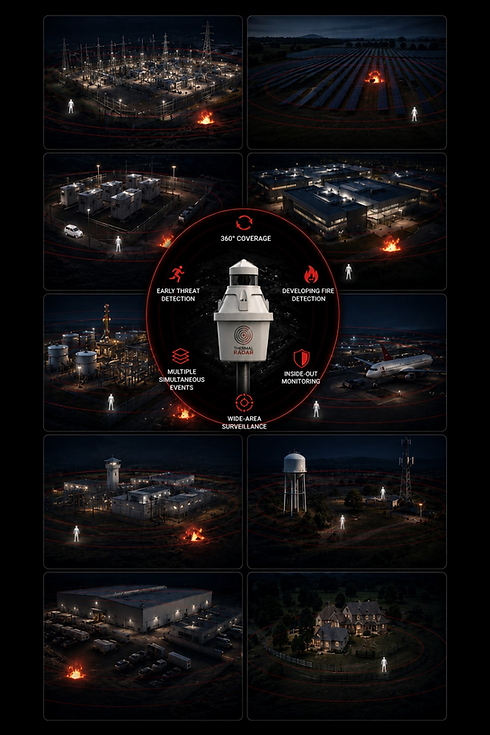
Wide-Area Thermal Monitoring for Critical Infrastructure and Large Properties
Thermal Radar™ is designed for outdoor environments where security teams must monitor more area than traditional fixed-camera architectures can efficiently cover.
Electrical Substations and Utilities
Monitor beyond, at, and inside utility perimeters for unauthorized activity, vehicles, thermal anomalies, and developing fire events near transformers, electrical equipment, and other critical assets.
Solar Farms and Renewable Energy Sites
Provide wide-area thermal intrusion detection and developing fire detection across expansive solar fields, battery installations, equipment areas, access roads, fence lines, and surrounding vegetation.
Battery Energy Storage Systems
Monitor BESS facilities for approaching intrusions, activity around the protected perimeter, and developing fire events that may require investigation.
Data Centers
Protect large data center campuses, electrical infrastructure, backup power systems, substations, equipment yards, construction areas, and other mission-critical outdoor assets.
Oil and Gas Facilities
Monitor remote and expansive facilities for unauthorized personnel, vehicles, perimeter activity, and developing fire conditions during both daytime and nighttime.
Airports, Ports, and Transportation Assets
Support continuous thermal perimeter surveillance around runways, cargo areas, storage yards, access roads, restricted zones, terminals, and other large operational environments.
Correctional Facilities
Monitor activity approaching the perimeter, at fence lines, between perimeter layers, and within designated protected areas.
Water and Communications Infrastructure
Extend wide-area thermal security to water facilities, pumping stations, telecommunications assets, utility sites, and other remote or unmanned infrastructure.
Industrial and Commercial Properties
Protect warehouses, manufacturing facilities, auto storage areas, recycling operations, equipment yards, construction sites, and other properties with large outdoor footprints.
Large Private Properties
Provide thermal perimeter monitoring for private ranches, estates, agricultural properties, equestrian facilities, and other remote or expansive private locations.
Large outdoor properties require more than a collection of disconnected camera views. They require continuous awareness of activity beyond the perimeter, at the perimeter, and throughout the protected area.
Thermal Radar™ provides wide-area 360° thermal monitoring for multiple simultaneous intrusions, developing fire events, and other qualifying thermal activity. By reducing camera count and supporting infrastructure, Thermal Radar™ can simplify installation, reduce licensing and maintenance requirements, and lower the total cost of ownership for perimeter security.
Whether you are protecting critical infrastructure, renewable energy assets, industrial facilities, transportation sites, remote equipment, or a large private property, Thermal Radar™ can be configured around your site layout, detection objectives, operating environment, and integration requirements.
Contact Thermal Radar to connect with an authorized representative and evaluate the right Thermal Radar™ configuration for your property.
Gallery


Frequently Asked Questions About Thermal Radar™ Perimeter Security
What is Thermal Radar™?
Thermal Radar™ is a patented 360° thermal surveillance and detection solution for wide-area perimeter security and early fire detection. It combines a rapidly rotating thermal sensor, onboard edge analytics, configurable detection rules, geospatial mapping, and security-system integration to monitor large outdoor areas during the day, at night, and through most weather conditions.
How is Thermal Radar™ different from a traditional thermal camera?
A traditional fixed thermal camera continuously monitors one field of view. Protecting a large property may require numerous cameras, mounting locations, network connections, and software licenses. Thermal Radar™ rotates a thermal sensor through 360 degrees to create a panoramic view of the monitored area, allowing one system to provide wide-area thermal coverage that might otherwise require multiple fixed cameras.
How is Thermal Radar™ different from visible-light security cameras?
Visible-light cameras rely on reflected light and may be affected by darkness, glare, shadows, camouflage, and changing illumination. Thermal Radar™ detects heat signatures without depending on visible light, allowing it to provide continuous monitoring during both daytime and nighttime. Visible-light and PTZ cameras can still be used as a complementary verification layer.
Can Thermal Radar™ monitor beyond the perimeter?
Yes. Thermal Radar™ supports an inside-out monitoring strategy that can detect qualifying activity beyond the protected perimeter, at the perimeter, and inside the protected property. Configurable areas of interest and detection rules allow different parts of the monitored environment to be managed according to site-specific risks.
Can Thermal Radar™ detect multiple intrusions simultaneously?
Yes. Thermal Radar™ can continuously detect and report multiple qualifying intrusion events across the monitored area. These can include multiple people, vehicles, or events occurring in different locations.
Can Thermal Radar™ detect fires and intrusions at the same time?
Yes. Thermal Radar™ can detect multiple developing fire events and intrusion events simultaneously. This allows security personnel to maintain awareness of different types of qualifying thermal activity occurring across the monitored site at the same time.
Does Thermal Radar™ prevent fires?
Thermal Radar™ does not prevent fires. Through fireSENSE™, it can help identify developing fire events based on detected thermal conditions so that qualified personnel can investigate and respond according to the organization’s safety and emergency procedures.
How does Thermal Radar™ lower total cost of ownership?
Thermal Radar™ can reduce the number of fixed thermal cameras and supporting components needed to monitor a large area. Depending on the deployment, this may reduce camera poles, trenching, cabling, power connections, network infrastructure, VMS licenses, maintenance requirements, replacement components, and long-term service costs.
Does Thermal Radar™ require a PTZ camera?
No. Thermal Radar™ can operate as a standalone thermal surveillance and detection solution. A compatible PTZ camera can be added when visual assessment is desired. Through Hydra™, qualifying Thermal Radar™ detections can direct the PTZ toward the geospatial location of an event.
Does Thermal Radar™ integrate with existing video management systems?
Yes. Thermal Radar™ integrates with a range of compatible VMS, PSIM, and physical security platforms. Integration capabilities may vary by platform, software version, configuration, and project requirements, so compatibility should be confirmed during system design.
How far can Thermal Radar™ detect a person or vehicle?
Detection distance depends on the selected sensor and lens, target characteristics, thermal contrast, installation height, terrain, environmental conditions, line of sight, analytics settings, and project requirements. Thermal Radar™ 3-Series and 6-Series configurations can support threat-detection distances of up to approximately 500 meters in appropriate applications.
Can Thermal Radar™ detect through buildings, trees, or solid objects?
No. Thermal imaging requires line of sight and cannot detect through buildings, walls, dense vegetation, or other solid obstructions. Proper placement and site design are important for achieving the desired coverage.
Does Thermal Radar™ work at night?
Yes. Thermal Radar™ detects heat signatures rather than depending on visible illumination, allowing it to monitor during both daytime and nighttime without requiring the monitored area to be brightly lit.
Does Thermal Radar™ work in bad weather?
Thermal Radar™ can provide useful monitoring through most weather conditions, but detection performance may be affected by environmental factors such as heavy precipitation, fog, atmospheric conditions, extreme thermal crossover, vegetation, and other site-specific variables.
Can Thermal Radar™ reduce false or nuisance alarms?
Thermal Radar™ provides configurable areas of interest, exclusion zones, blur masks, sensitivity settings, confidence thresholds, schedules, and detection rules that help operators focus on meaningful activity. Proper system configuration can reduce alarms caused by authorized movement, repetitive activity, wildlife, vegetation, weather, and other site-specific conditions.
What types of facilities use Thermal Radar™?
Thermal Radar™ can be used at electrical substations, solar farms, battery energy storage systems, data centers, oil and gas facilities, airports, ports, correctional facilities, transportation yards, water infrastructure, industrial properties, warehouses, remote utility sites, large private properties, and most any other wide-area location where detection is needed.
Is Thermal Radar™ available for remote or off-grid sites?
Yes. Thermal Radar™ can be permanently installed or deployed through solar-powered options such as Mobile Sentry™ and Tower Sentry™ for remote locations where commercial power or permanent infrastructure may be limited.
Can Thermal Radar™ be used for temporary security deployments?
Yes. Mobile Sentry™, Tower Sentry™, and Banshee™ provide rapidly deployable options for construction projects, facility expansions, temporary operations, emergency requirements, remote infrastructure, and other locations where permanent installation may not be practical.
How do I determine which Thermal Radar™ configuration my site needs?
The appropriate configuration depends on the size and layout of the property, target types, required detection distances, terrain, obstructions, mounting height, environmental conditions, integration requirements, and operational objectives. The Thermal Radar™ Layout Tool can support preliminary planning, followed by a site-specific evaluation with Thermal Radar or an authorized representative.
Where can I purchase Thermal Radar™?
Thermal Radar™ systems are available through authorized security integrators and representatives in the United States and international markets. Visit the Where to Buy Thermal Radar™ page to locate the appropriate representative for your region.