
How Does Thermal Imaging Radar Work for Security?
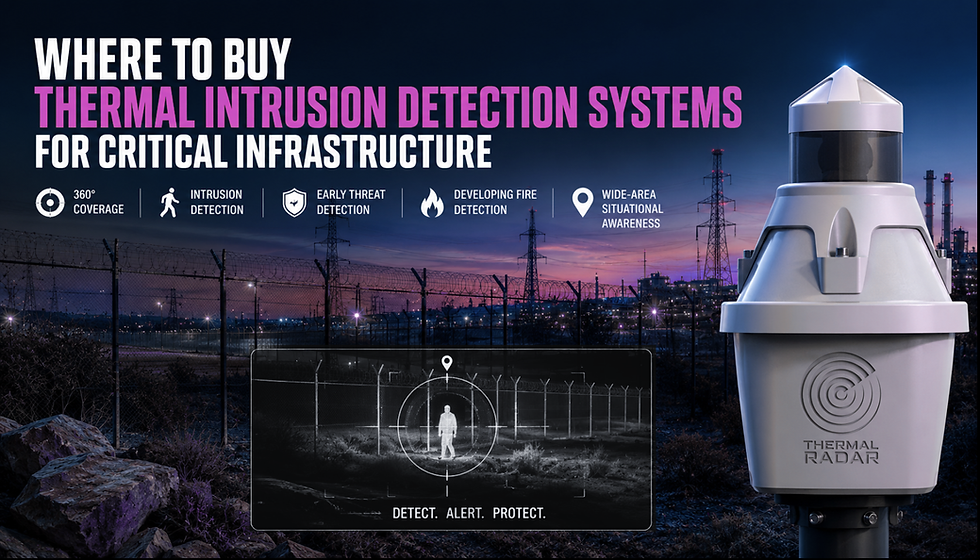
Thermal Radar™ uses a rotating thermal sensor, geospatial positioning, and edge-based analytics to provide 360° wide-area security monitoring. Instead of relying on visible light, it detects differences in infrared energy, or heat, to identify, classify, and locate potential threats such as people and vehicles across large outdoor environments.
With the optional fireSENSE™ capability, the same Thermal Radar™ platform can also detect developing early fire events.
But there is an important distinction to understand when discussing thermal imaging radar: thermal imaging and traditional radar are not the same sensing technology.

Is Thermal Imaging the Same as Radar?
No. A conventional thermal camera is not radar.
Thermal imaging is a passive technology that detects infrared energy emitted by objects and converts differences in thermal energy into an image.
Traditional radar is active technology. It transmits radio-frequency energy and analyzes returned signals to gather information about objects within its coverage area.
So where does the term Thermal Radar™ come from?
Thermal Radar™ is patented technology developed by Thermal Imaging Radar that applies a radar-like approach to wide-area situational awareness using a rotating thermal imaging sensor.
It does not transmit radio waves like conventional radar. Instead, Thermal Radar™ repeatedly scans the surrounding environment with thermal imaging to provide 360° detection and location information.
This creates an important distinction:
Thermal imaging = the sensing technology.
Traditional radar = a different active sensing technology.
Thermal Imaging Radar = the company.
Thermal Radar™ = patented rotating thermal detection technology.
How Does Thermal Imaging Work for Security?
Every object with a temperature above absolute zero emits infrared energy.

A thermal sensor detects differences in that energy and converts them into thermal imagery.
People, vehicles, equipment, terrain, vegetation, buildings, and other objects can therefore appear based on their thermal contrast rather than the visible light reflecting from them.
This is particularly valuable for outdoor security because a thermal camera does not require visible illumination to detect thermal contrast.
A person approaching a perimeter in complete darkness, for example, may be difficult for a conventional visible-light camera to detect without sufficient lighting. A thermal sensor can detect the thermal contrast between that person and the surrounding environment.
That makes thermal imaging useful for perimeter security, nighttime surveillance, critical infrastructure protection, intrusion detection, and wide-area outdoor monitoring.
How Does Thermal Radar™ Work?
Traditional thermal security cameras typically remain pointed toward a defined field of view.
Thermal Radar™ works differently.
The Thermal Radar™ sensor rotates through 360° and can stop at multiple configured positions around the protected property. At each position, the system captures thermal imagery and analyzes the scene before continuing its scan.
This allows a single rotating thermal sensor to repeatedly monitor multiple areas surrounding its installation point.
Depending on the Thermal Radar™ model, mounting height, terrain, environmental conditions, configuration, and line-of-sight, a single system can provide thermal monitoring across up to approximately 220 acres.
For large properties, this approach can reduce the number of individual cameras, mounting locations, power connections, network connections, licenses, and other infrastructure that may be required when attempting to achieve comparable wide-area coverage with numerous fixed cameras.
How Does Thermal Radar™ Detect an Intruder?
Capturing thermal imagery is only one part of the process.
Thermal Radar™ uses edge-based analytics to analyze thermal imagery and identify objects or events that meet configured detection criteria.
The system can detect and classify objects such as people and vehicles within designated monitoring areas.
When a qualified detection occurs, Thermal Radar™ can determine the geographic location of the event and provide that information to the security system.
Instead of requiring an operator to continuously watch numerous video feeds and notice something unusual, Thermal Radar™ is designed to help identify what has been detected and where the event is occurring.
What Does 360° Thermal Detection Mean?
A fixed thermal camera observes the area within its field of view.
Thermal Radar™ repeatedly rotates around its installation point, allowing the system to monitor configured areas in multiple directions.
This creates 360° wide-area thermal monitoring from a single platform.
It does not mean that physical obstructions disappear. Like other camera-based technologies, Thermal Radar™ requires appropriate line-of-sight to the areas being monitored. Buildings, walls, terrain, dense objects, and other physical obstructions can block the sensor's view. Proper system placement and site design are therefore important to achieving effective coverage.
Can Thermal Radar™ Detect Threats Outside a Fence?
Yes, when site layout and line-of-sight permit.
Perimeter security is often designed around the physical boundary of a property. But waiting until someone reaches the fence may sacrifice valuable response time.
Thermal Radar™ can be configured for inside-out perimeter monitoring, allowing organizations to establish detection areas beyond the perimeter, at the perimeter, and inside the protected property.
For example, a site may establish an area of interest beyond a fence so an approaching person or vehicle can generate a qualified detection before reaching the physical perimeter.
Additional monitoring areas can then provide detection at the fence and within the protected property.
This layered approach can provide earlier situational awareness than security strategies focused exclusively on activity occurring directly at the perimeter.
Can Thermal Radar™ Reduce False or Unwanted Alarms?
Security environments are rarely identical, so detection rules need to reflect the property being protected.
Thermal Radar™ provides configurable analytics tools that can include areas of interest, exclusion zones, blur masks, sensitivity settings, confidence thresholds, scheduling, and customizable detection rules.
These tools allow system designers and operators to determine where detection should occur, where activity should be ignored, and how the system should respond to different conditions.
The objective is not simply to detect everything that moves. It is to help identify activity that meets the site's defined detection requirements.
Does Thermal Radar™ Work in Complete Darkness?
Yes. Thermal imaging does not require visible illumination to detect thermal contrast. Thermal Radar™ can therefore provide detection during daylight and complete darkness.
This is one of the primary advantages of thermal technology for perimeter security.
Thermal Radar™ can also operate in most weather conditions, although environmental conditions, thermal contrast, terrain, obstructions, sensor configuration, and line-of-sight can affect detection performance.
Can Thermal Radar™ Identify Who a Person Is?
Thermal Radar™ is primarily designed for detection, classification, location, and situational awareness, not facial identification.
A thermal image can reveal the presence and movement of a person based on thermal contrast, but visible-light imagery may be useful when security personnel need additional visual information about a detected event.
This is where layered detection and verification can become valuable.
How Does Thermal Radar™ Work With a PTZ Camera?
Thermal Radar™ can operate as a standalone detection technology or can be paired with a compatible PTZ camera through Hydra™.
When Thermal Radar™ identifies a qualified detection, the PTZ can be directed toward the detected location for visual assessment.
This combines two different security functions:
Thermal Radar™ provides wide-area 360° thermal detection.
The PTZ provides directed visual assessment of the detected event.
This layered approach allows the thermal detection system to monitor a large environment while the PTZ provides operators with additional visual information about qualified events.
Can Thermal Imaging Radar Detect Fires?
Thermal Radar™ can also provide early fire detection when equipped with the optional fireSENSE™ capability.
Because thermal technology responds to thermal energy rather than visible smoke or flames alone, it can identify thermal anomalies associated with developing fire events.
This allows organizations to use the Thermal Radar™ platform to monitor for both security intrusions and developing fire events.
That combination can be particularly valuable at sites such as:
Electrical substations
Solar farms
Battery energy storage systems
Utilities
Industrial facilities
Recycling operations
Mining sites
Oil and gas facilities
Data centers
Other critical infrastructure
Where Is Thermal Radar™ Used for Security?
Thermal Radar™ is designed primarily for outdoor environments where security teams need to monitor more area than traditional fixed-camera architectures can efficiently cover.
Applications can include utilities, electrical substations, renewable energy facilities, solar farms, BESS facilities, data centers, airports, ports, transportation infrastructure, mining operations, oil and gas facilities, industrial properties, warehouses, water infrastructure, government facilities, correctional facilities, remote infrastructure, and large private properties.
The appropriate configuration depends on the property's size, terrain, perimeter, existing security infrastructure, detection objectives, and environmental conditions.
Can Thermal Radar™ Be Used at Remote Sites?
Yes. Thermal Radar™ can be incorporated into permanent security installations or deployed through platforms designed for sites where traditional infrastructure may be impractical.
Mobile Sentry™ and Tower Sentry™ are solar-powered Thermal Radar™ deployment options that can be used for remote sites and other locations where commercial power may be limited or unavailable.
Banshee™ provides an additional solar-powered option with additional deterrence technologies on board.
Why Use Thermal Radar™ Instead of Multiple Fixed Thermal Cameras?
There is no single camera architecture that is appropriate for every property.
However, large outdoor sites can require many fixed cameras when each camera is responsible for monitoring only one defined field of view.
Thermal Radar™ was designed to address that challenge differently.
By rotating a thermal sensor through multiple configured monitoring positions, one Thermal Radar™ system can provide wide-area detection across multiple directions.
For appropriate sites, this can help reduce camera counts and associated infrastructure while providing 360° thermal detection, geospatial awareness, thermal intrusion detection, and continuous perimeter monitoring from a centralized platform.
Thermal Imaging + 360° Scanning + Analytics
So, how does thermal imaging radar work for security? Thermal Radar™ combines the ability of thermal imaging to detect differences in heat with patented 360° rotating technology, geospatial positioning, and analytics.
The result is a wide-area security platform designed to:
Detect people and vehicles
Monitor large outdoor environments
Provide detection during daylight and complete darkness
Monitor beyond, at, and inside a perimeter
Geolocate qualified detections
Support directed PTZ visual assessment through Hydra™
Detect developing fire events with optional fireSENSE™
Provide flexible permanent and solar-powered deployment options
Thermal Radar™ is developed and manufactured by Thermal Imaging Radar, headquartered in Orem, Utah, and is deployed through security integrators and partners for organizations across the United States and internationally.
For organizations responsible for protecting large outdoor environments, Thermal Radar™ provides a different approach to perimeter security, perimeter protection, wide-area thermal monitoring, early threat detection, and critical infrastructure security.
Frequently Asked Questions About Thermal Imaging Radar for Security
Is thermal imaging radar the same as radar?
No. Traditional radar transmits radio-frequency energy and analyzes returned signals. Thermal Radar™ uses passive thermal imaging to detect infrared energy. Thermal Radar™ is patented rotating thermal detection technology developed by Thermal Imaging Radar.
How does Thermal Radar™ detect people?
Thermal Radar™ uses thermal imaging to detect thermal contrast within the environment. Analytics analyze the imagery and can identify and classify people that meet configured detection criteria.
Can Thermal Radar™ detect vehicles?
Yes. Thermal Radar™ analytics can detect and classify vehicles within configured monitoring areas.
Does Thermal Radar™ work without light?
Yes. Thermal imaging does not require visible illumination to detect thermal contrast, allowing Thermal Radar™ to provide detection during daylight and complete darkness.
Does Thermal Radar™ provide 360° coverage?
Thermal Radar™ uses a rotating thermal sensor to repeatedly monitor configured positions around the system. Effective coverage depends on system placement, terrain, environmental conditions, obstructions, line-of-sight, model, and configuration.
Can Thermal Radar™ see through walls?
No. Thermal Radar™ requires line-of-sight to monitored areas and cannot see through walls, buildings, or other solid obstructions.
How is Thermal Radar™ different from a fixed thermal camera?
A fixed thermal camera continuously monitors one defined field of view. Thermal Radar™ rotates through multiple station stops, allowing one system to repeatedly monitor multiple areas around the sensor.
Can Thermal Radar™ monitor outside a security perimeter?
Yes, when site conditions and line-of-sight allow. Thermal Radar™ can be configured to monitor beyond the perimeter, at the perimeter, and inside the protected property.
Can Thermal Radar™ detect intrusions and developing fires at the same site?
Yes. Thermal Radar™ provides intrusion detection, and systems equipped with the optional fireSENSE™ capability can also detect developing fire events.
Can Thermal Radar™ work with a PTZ camera?
Yes. Hydra™ combines Thermal Radar™ with a compatible PTZ camera to provide wide-area thermal detection and directed visual assessment.
Who makes Thermal Radar™?
Thermal Radar™ is developed and manufactured by Thermal Imaging Radar, a U.S.-based security technology company headquartered in Orem, Utah.


Comments