
How 360-Degree Thermal Surveillance Reduces False Alarms in Perimeter Security
Updated: Jul 21
False alarms remain one of the biggest challenges in perimeter security. When security personnel are forced to respond to repeated nuisance alerts, valuable time and resources are wasted. Over time, excessive false alarms can also lead to alert fatigue, causing operators to become less responsive to legitimate threats.
As organizations look for more effective ways to secure critical infrastructure, industrial facilities, utility sites, solar farms, battery energy storage systems (BESS), data centers, airports, ports, and border environments, many are turning to 360-degree thermal surveillance as a way to improve detection accuracy while reducing unnecessary alerts.
The question is simple:
How does 360-degree thermal surveillance reduce false alarms?
The answer involves a combination of continuous coverage, thermal detection technology, advanced analytics, and improved situational awareness.
What Is 360-Degree Thermal Surveillance?
360-degree thermal surveillance is a security approach that continuously monitors an entire area using thermal imaging technology capable of detecting heat signatures across all directions.
Unlike traditional security systems that rely solely on visible-light cameras, thermal surveillance detects temperature differences between objects and their surroundings. This allows the system to identify people, vehicles, and developing fire events regardless of lighting conditions.
When combined with continuous panoramic coverage, operators gain a complete view of the protected environment rather than relying on multiple isolated camera views.
False Alarms Often Begin with Limited Visibility
Many false alarms occur because conventional surveillance systems struggle to accurately interpret what they are seeing.
Common causes include:
Shadows
Sun glare
Headlights
Reflections
Changing lighting conditions
Weather effects
Camera blind spots
Incomplete coverage
Wildlife movement
Vegetation motion
Traditional video analytics frequently depend on visible imagery, making them vulnerable to environmental factors that can generate nuisance alerts.
The result is often a high volume of notifications that require manual verification.
Continuous 360-Degree Coverage Can Eliminate Blind Spots
One of the primary advantages of 360-degree thermal surveillance is the ability to maintain continuous visibility across the entire monitored area.
Blind spots create uncertainty.
When portions of a perimeter are not actively monitored, security systems may lose track of objects as they move between camera fields of view. This can lead to fragmented tracking, inconsistent detections, and unnecessary alerts.
Continuous panoramic coverage can help security teams:
Maintain awareness across the entire perimeter
Track targets more consistently
Reduce coverage gaps
Improve event correlation
Increase confidence in detections
By observing the complete environment rather than isolated camera views, security operators gain better context when evaluating potential threats.

Thermal Detection Is Not Dependent on Lighting Conditions
A major reason thermal surveillance reduces false alarms is that thermal sensors detect heat rather than visible light.
Visible-light cameras can struggle during:
Nighttime conditions
Sunrise and sunset
Bright sunlight
Shadows
Thermal imaging remains more effective because it focuses on temperature differences rather than scene illumination.
This allows thermal systems to detect:
People
Vehicles
Developing fire events
in complete darkness and many challenging environmental conditions.
Because thermal imagery is not dependent on ambient lighting, security systems can operate with greater consistency throughout the day and night.
Improved Detection of Actual Threats
Reducing false alarms is not only about filtering nuisance events. It is also about improving the ability to identify genuine threats.
Thermal surveillance helps security teams focus on meaningful activity by detecting the thermal signatures associated with people and vehicles.
Rather than responding to lighting changes or visual distractions, operators can concentrate on events that represent actual security concerns.
This improves both detection performance and operational efficiency.
Analytics Further Improve Alarm Accuracy
Modern thermal surveillance systems often incorporate intelligent analytics to help distinguish legitimate threats from non-threatening activity.
Analytics may evaluate factors such as:
Object size
Movement patterns
Direction of travel
Speed
Persistence
Location
These capabilities help reduce unnecessary alerts while improving overall detection confidence.
However, effective false alarm reduction extends beyond basic object classification. Modern thermal analytics also provide configurable detection rules that allow security teams to tailor the system to the operational requirements of each facility.
This is particularly important for large outdoor environments where certain areas experience predictable movement while others require continuous monitoring.
Security operators can configure Areas of Interest (AOIs) to prioritize critical assets, access roads, equipment yards, substations, transformer areas, battery energy storage systems (BESS), loading zones, fence lines, gates, and other high-value locations. Activity occurring within these designated zones can trigger alerts based on customized rules while reducing unnecessary notifications from less critical areas.
Likewise, Exclusion Zones can be established to intentionally ignore activity occurring in locations where routine movement is expected. Roads with authorized vehicle traffic, public walkways, maintenance areas, vegetation, or other non-critical regions can be excluded from alarm generation, allowing operators to focus on events that matter most.
Additional filtering capabilities such as blur masks can prevent analytics from processing portions of the scene that contain repetitive motion or objects that should not generate alarms. This helps minimize nuisance alerts caused by moving trees, flags, nearby road traffic, reflections, or other environmental distractions.
Operators can also fine-tune system performance using configurable sensitivity settings and confidence thresholds. These controls determine how readily the analytics classify an object as a potential threat before generating an alarm.
Increasing sensitivity may improve the detection of smaller or more distant targets, while adjusting confidence thresholds can reduce nuisance alarms by requiring stronger evidence before an alert is issued. Properly balancing these settings allows organizations to optimize detection performance for the specific operational environment.
When these configurable analytics work together, security teams can distinguish genuine security events from repetitive movement, wildlife, changing weather conditions, and authorized personnel or vehicle activity.
Rather than overwhelming operators with constant notifications, the system delivers more meaningful alerts that support faster assessment, improved situational awareness, and more efficient security operations.
For example, analytics can be configured to prioritize:
Human intrusions
Vehicle activity
Restricted-area access
Areas of Particular Interest
Developing fire conditions
while minimizing alerts associated with environmental changes, authorized activity, wildlife, or repetitive background movement.
The combination of thermal detection, continuous 360-degree surveillance, and configurable analytics creates a more reliable security solution than either technology alone, helping reduce nuisance alarms while minimizing operator fatigue and improving overall perimeter security performance.
Wide-Area Coverage Can Reduce System Complexity
Many conventional perimeter security deployments require large numbers of cameras to achieve full coverage.
As camera counts increase, organizations often encounter:
Additional infrastructure requirements
Increased licensing costs
More maintenance
Greater configuration complexity
Higher risk of coverage gaps
Wide-area thermal surveillance can help simplify deployment by monitoring larger areas from fewer sensor locations.
This streamlined approach can improve consistency while reducing the number of potential failure points within the overall security system.
Fire Detection and Intrusion Detection from a Single Platform
Another advantage of advanced thermal surveillance systems is the ability to simultaneously monitor for multiple types of threats.
Certain thermal surveillance solutions can detect:
Human intrusions
Vehicle intrusions
Unauthorized access
Developing fire events
Abnormal heat signatures
from the same platform.
This allows organizations to improve overall situational awareness while reducing the need for multiple independent detection technologies.
Why Thermal Radar™ Is Different
Not all thermal surveillance systems are designed the same way.
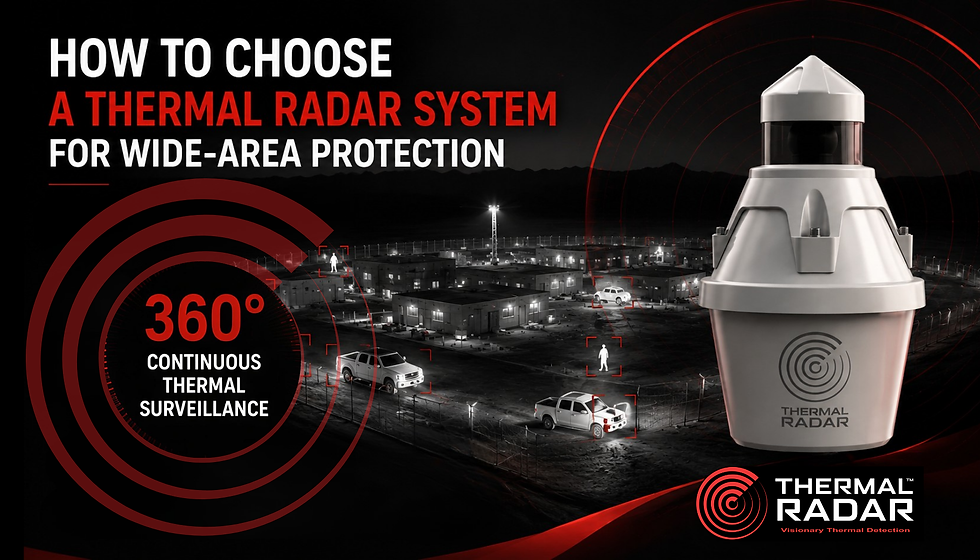
Thermal Radar™ was developed to provide continuous 360-degree thermal detection across large outdoor environments using patented technology designed specifically for wide-area surveillance.
Unlike traditional approaches that often rely on arrays of fixed cameras, Thermal Radar™ continuously scans the protected area while providing:
360-degree situational awareness
Human detection
Vehicle detection
Fire detection
Geolocated alerts
Advanced analytics
PTZ slew-to-cue integration
Large-area coverage, often from a single deployment point
By combining continuous panoramic coverage with thermal detection and intelligent analytics, Thermal Radar™ helps organizations improve threat detection while minimizing nuisance alarms that can overwhelm security teams.
Conclusion
360-degree thermal surveillance can reduce false alarms by combining continuous perimeter visibility, heat-based detection, intelligent analytics, configurable detection rules, and improved situational awareness. Features such as Areas of Interest, Exclusion Zones, blur masks, sensitivity adjustments, and confidence thresholds allow organizations to tailor detection behavior for their specific environment, helping security personnel focus on genuine threats while reducing nuisance alarms and operator fatigue.
While no security technology can completely eliminate nuisance alerts, thermal surveillance can provide a more reliable method of detecting legitimate threats than systems that rely solely on visible-light cameras.
For organizations seeking to improve perimeter security performance while reducing unnecessary alarms, 360-degree thermal surveillance offers a powerful approach that can enhance detection accuracy, simplify operations, and improve overall security effectiveness.
As threats continue to evolve, technologies like Thermal Radar™ are helping organizations move beyond traditional camera-based monitoring toward more intelligent and comprehensive perimeter protection.
Frequently Asked Questions
Does 360-degree thermal surveillance eliminate false alarms completely?
No security technology can completely eliminate false alarms. However, 360-degree thermal surveillance can significantly reduce nuisance alerts by combining continuous coverage, thermal detection, and intelligent analytics.
How do Areas of Interest and Exclusion Zones reduce false alarms?
Areas of Interest (AOIs) allow security operators to prioritize critical assets and high-security locations where detections should generate alerts. Exclusion Zones identify areas where routine activity is expected and should be ignored. Combined with configurable sensitivity settings, confidence thresholds, blur masks, and intelligent analytics, these tools help distinguish legitimate threats from wildlife, weather, repetitive movement, and authorized personnel, significantly reducing nuisance alarms while improving overall perimeter security effectiveness.
Does thermal imaging reduce false alarms compared to traditional cameras?
Yes. Thermal imaging often reduces false alarms because it detects heat signatures rather than visible images.
How does 360-degree thermal surveillance reduce false alarms?
360-degree thermal surveillance reduces false alarms by combining continuous perimeter coverage with heat-based detection. Unlike traditional cameras that rely on visible light, thermal systems detect temperature differences, making them less susceptible to shadows, glare, headlights, and changing lighting conditions. Continuous coverage also helps eliminate blind spots, while advanced analytics can verify events and filter out non-threats, resulting in more accurate alerts and fewer nuisance alarms.
Can thermal surveillance work at night?
Yes. Thermal imaging systems can detect people, vehicles, and other heat-producing objects in complete darkness.
Is 360-degree thermal surveillance suitable for large outdoor facilities?
Yes. Thermal surveillance is commonly used to protect large areas such as utility infrastructure, solar farms, substations, battery energy storage sites, airports, ports, industrial facilities, and border environments.
Can one thermal surveillance system detect both intrusions and fires?
Yes. Some advanced thermal surveillance platforms, like Thermal Radar™, can simultaneously detect human intrusions, vehicle activity, abnormal heat signatures, and developing fire events. By combining intrusion detection and fire detection capabilities into a single system, organizations can improve operational awareness while reducing the need for multiple independent monitoring technologies.
How does Thermal Radar™ provide continuous perimeter coverage?
Thermal Radar™ provides continuous perimeter coverage through patented rotating thermal imaging technology that delivers 360-degree situational awareness. Rather than relying on multiple fixed cameras, Thermal Radar™ continuously scans the protected environment, detecting people, vehicles, and developing fire events across large outdoor areas. This approach helps eliminate blind spots and provides operators with a comprehensive view of the monitored site.


Comments