
Best Thermal Surveillance Systems for Perimeter Security in Orem
Updated: Aug 7
Whether a facility is located in Orem, Utah, a utility substation in Florida, a solar farm in Texas, a data center in Virginia, or critical infrastructure overseas, perimeter security programs face many of the same challenges: detecting threats early, reducing false alarms, and maintaining awareness across large outdoor environments.
This reality has fundamentally changed how organizations evaluate perimeter security technology. The conversation is no longer centered on individual cameras or isolated detection devices. Instead, security professionals increasingly focus on how detection, verification, analytics, and situational awareness work together to provide a more complete understanding of activity occurring across an entire site.
That shift helps explain why discussions about the best thermal surveillance systems for perimeter security in Orem often extend far beyond camera specifications. Modern perimeter protection increasingly relies on layered security architectures that combine thermal detection, intelligent analytics, visual verification, and geospatial awareness to help operators detect, assess, and respond to potential threats more effectively.
The Evolution of Thermal Surveillance for Perimeter Security
Perimeter security has traditionally been built around observation. Cameras captured activity, operators reviewed footage, and security personnel responded when events occurred.
Today's expectations are very different. Organizations want earlier detection, fewer nuisance alarms, faster verification, and more meaningful operational awareness. Security systems are expected to identify activity, classify events, prioritize alerts, and provide context that supports rapid decision-making.
Thermal surveillance has become a valuable component of this evolution because it serves as an effective detection layer. By identifying heat signatures rather than relying solely on visible light, thermal technologies help security teams recognize activity regardless of lighting conditions.
As security strategies continue to mature, thermal detection is increasingly viewed as part of a broader security architecture rather than simply another camera technology.
Detection vs. Verification: Why Both Matter
One of the most important principles in modern perimeter security is understanding the difference between detection and verification.
Detection answers the question:
Is something there?
Verification answers the question:
What is it?
A thermal detection may indicate activity near a fence line, perimeter road, utility asset, access point, or restricted area. While that detection provides valuable awareness, operators still need additional information before determining an appropriate response.
This is why many perimeter security systems combine thermal detection technologies with PTZ cameras and visual verification workflows. Thermal systems help identify activity. Verification systems help explain activity. Together, they provide a more complete operational picture.
The Role of Analytics in Modern Security Operations
As facilities grow larger and more complex, analytics have become increasingly important. Security teams often manage thousands of acres, multiple assets, and numerous potential points of interest. Without intelligent filtering and prioritization, operators can quickly become overwhelmed by information.
Modern analytics help transform detections into actionable events. These technologies may support:
Human and vehicle classification
Area-of-interest monitoring
Event prioritization
Alarm filtering
Automated alerting
Operational workflow enhancement
The objective is not to generate more alarms. The objective is to generate more meaningful alarms. This distinction is one of the reasons analytics have become such a critical component of modern perimeter security architectures.
Beyond Fixed Camera Views: The Rise of Wide-Area Situational Awareness
Traditional surveillance systems often focus on specific fields of view. As environments become larger, this approach frequently requires additional cameras, poles, power infrastructure, networking equipment, software licenses, and ongoing maintenance.
Many organizations are now pursuing a different objective. They want situational awareness. Situational awareness is the ability to understand what is happening across an entire environment rather than simply observing isolated portions of it.
Security personnel increasingly need answers to questions such as:
Where is the activity occurring?
How is the activity moving?
Which assets may be affected?
Does the event require intervention?
How quickly should personnel respond?
This growing emphasis on whole-environment awareness has helped drive interest in technologies specifically designed to support wide-area monitoring.
What Defines the Best Thermal Surveillance Systems for Perimeter Security in Orem?
The answer is rarely found in a single device. The most effective thermal surveillance systems combine multiple technologies that work together to support operational awareness.
For some environments, fixed thermal cameras integrated with analytics and PTZ verification may provide an effective solution.
For many others, broader awareness across extensive operational environments may be more important than monitoring individual camera views.
Security professionals often evaluate thermal surveillance systems based on factors such as:
Detection capabilities
Verification workflows
Analytics integration
Situational awareness
Infrastructure requirements
Scalability
Operational efficiency
Long-term adaptability
The best thermal surveillance systems for perimeter security in Orem are often the same types of systems being evaluated for critical infrastructure, renewable energy facilities, transportation networks, industrial operations, and large outdoor environments around the world.
Thermal Radar™ and 360° Thermal Surveillance

As organizations place greater emphasis on situational awareness, technologies capable of monitoring broader environments have become increasingly relevant.
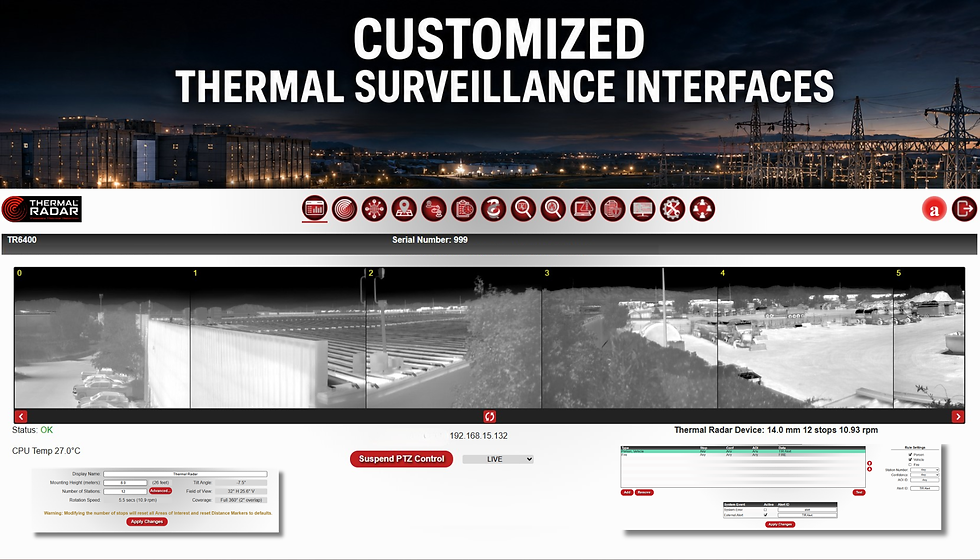
Thermal Radar™ was developed around this concept. Using patented rotating thermal detection technology, Thermal Radar™ continuously scans a 360-degree environment while providing geospatial awareness of detected activity.
Rather than focusing exclusively on a single field of view, the system is designed to help operators understand activity occurring across a larger operational area.
Key capabilities include:
Continuous 360° thermal detection
Wide-area intrusion detection
Geospatial awareness
Configurable areas of interest
Detection of people and vehicles
Detection of developing fire events
Automated alerting
PTZ integration through Hydra™
This approach supports the broader industry movement toward systems that provide operational awareness rather than simply collecting video.
Thermal Surveillance Applications Across Critical Infrastructure
The same security challenges that drive thermal surveillance adoption in Utah also influence security strategies across the globe.
Utilities and Electrical Infrastructure
Substations, transmission facilities, and utility assets often require continuous monitoring across expansive outdoor environments where early awareness can support both security and operational objectives.
Renewable Energy Facilities
Solar farms and battery energy storage systems frequently span large geographic areas and benefit from technologies designed for wide-area monitoring.
Data Centers
Data center operators often utilize layered security architectures that support perimeter awareness around mission-critical infrastructure.
Transportation and Logistics
Airports, ports, rail facilities, and distribution centers commonly require monitoring across extensive operational footprints.
Industrial and Mining Operations
Industrial facilities and mining environments frequently present unique challenges related to scale, geography, and operational complexity.
While the environments vary, the security objectives remain remarkably similar: detect activity earlier, improve awareness, and support more informed decision-making.
The Future of Outdoor Security Operations
Perimeter security continues to evolve toward integrated ecosystems that combine detection, verification, analytics, geospatial awareness, and intelligent alerting into a unified operational picture.
Organizations are increasingly investing in technologies that provide context rather than simply collecting information. Thermal Imaging Radar, analytics, automated verification, and wide-area situational awareness are becoming interconnected components of modern security strategies designed to support proactive decision-making.
The future of perimeter security will be defined by technologies that deliver earlier detection, greater situational awareness, and more actionable intelligence while reducing operational complexity.
As organizations seek to protect larger and more complex environments, security solutions that can monitor broader areas, provide meaningful context, and support faster decision-making will continue to play an increasingly important role.
Frequently Asked Questions
What are the best thermal surveillance systems for perimeter security in Orem?
The best thermal surveillance systems for perimeter security in Orem depend on the size of the environment, operational objectives, and situational awareness requirements. Many organizations utilize a layered approach that combines thermal detection, analytics, and visual verification. For large outdoor environments, Thermal Radar™ provides a patented 360° thermal surveillance solution that combines wide-area intrusion detection, geospatial awareness, automated alerting, and optional PTZ verification through Hydra™, helping organizations maintain awareness beyond, at, and within the perimeter.
Why are thermal cameras used for perimeter security?
Thermal cameras detect heat signatures rather than visible light, allowing them to support detection during nighttime conditions and in many challenging outdoor environments. Because thermal systems do not rely solely on ambient lighting, they are commonly used to improve perimeter awareness, enhance detection capabilities, and support security operations across large outdoor environments.
What is the difference between thermal detection and visual verification?
Thermal detection identifies activity by detecting heat signatures emitted by people, vehicles, equipment, fires, or other objects. Visual verification provides additional context by allowing operators to assess what has been detected and determine whether a response is required.
Many modern perimeter security architectures use thermal technologies for detection and PTZ or optical cameras for verification. For example, Thermal Radar™ provides wide-area thermal detection and geospatial awareness, while Hydra™ can automatically direct a PTZ camera toward qualified detections for visual verification. This layered approach helps security teams improve situational awareness and make more informed response decisions.
Why are PTZ cameras commonly paired with thermal surveillance systems?
PTZ cameras provide visual verification following a detection event, helping operators assess activity and determine appropriate response actions.
What is situational awareness in perimeter security?
Situational awareness refers to understanding what is happening across an environment, where activity is occurring, how it is moving, and how it relates to protected assets and operational objectives.
How does Thermal Radar™ differ from traditional fixed thermal cameras?
Fixed thermal cameras continuously monitor a specific field of view. Thermal Radar™ uses patented rotating thermal detection technology to provide continuous 360-degree situational awareness across large outdoor environments. This allows organizations to monitor broader areas while maintaining geospatial awareness of detected activity and reducing infrastructure requirements compared to traditional multi-camera deployments.
Can Thermal Radar™ integrate with PTZ cameras?
Yes. Thermal Radar™ integrates with PTZ cameras through Hydra™, allowing qualified detections to automatically direct cameras toward event locations for visual verification.
Can thermal surveillance help reduce false alarms?
When combined with analytics and verification technologies, thermal surveillance systems can help reduce nuisance alarms while improving operator efficiency.
Can thermal surveillance detect both intrusions and developing fire events?
Some advanced thermal surveillance technologies support both intrusion detection and developing fire event detection within the same operational environment.
What is wide-area thermal intrusion detection?
Wide-area thermal intrusion detection refers to the ability to monitor large outdoor environments and identify activity occurring across broad operational areas. Thermal Radar™ was specifically designed for this purpose, providing continuous 360° thermal detection and geospatial awareness that helps operators understand where activity is occurring relative to critical assets and infrastructure.
What industries commonly use thermal surveillance systems?
Utilities, renewable energy facilities, substations, airports, ports, transportation infrastructure, industrial operations, mining facilities, warehouses, data centers, and other large outdoor environments commonly utilize thermal surveillance technologies.
What are the best thermal surveillance systems for perimeter security?
The best thermal surveillance systems for perimeter security are those that effectively combine thermal detection, intelligent analytics, visual verification, and situational awareness. The optimal solution depends on the size of the environment, operational objectives, infrastructure constraints, and response requirements.
Many modern perimeter security programs utilize a layered approach that combines thermal detection technologies with analytics, PTZ verification, and centralized monitoring platforms. For large outdoor environments, Thermal Radar™ provides a patented 360° thermal surveillance solution that combines wide-area intrusion detection, geospatial awareness, automated alerting, and optional PTZ verification through Hydra™, helping organizations maintain awareness beyond, at, and within the perimeter.
What are the advantages of 360-degree thermal surveillance?
360-degree thermal surveillance can provide broader environmental awareness than systems limited to individual fields of view. Benefits may include expanded coverage, reduced blind spots, improved situational awareness, geospatial tracking of activity, and the ability to monitor multiple areas of interest from a single deployment location.
Thermal Radar™ was specifically developed around this concept, using patented rotating thermal detection technology to continuously monitor a 360-degree environment while providing geospatial awareness of detected activity. This approach is particularly valuable for large outdoor environments where maintaining awareness beyond, at, and within the perimeter is a priority.
Can thermal surveillance detect intruders at night?
Yes. Thermal surveillance technologies detect heat signatures rather than relying on visible light, making them highly effective for identifying people and vehicles during nighttime conditions. This capability is one of the primary reasons thermal surveillance has become widely adopted for perimeter security applications.
Thermal Radar™ leverages thermal detection technology to provide continuous 360° monitoring and wide-area intrusion detection, helping security teams maintain awareness of activity across large outdoor environments regardless of lighting conditions. By detecting heat signatures rather than relying on visible illumination, Thermal Radar™ can help identify potential threats day or night while providing geospatial awareness of detected activity.
How can thermal imaging reduce false alarms?
Thermal imaging can help reduce nuisance alarms by focusing on heat-producing objects rather than relying exclusively on changes in visible imagery. When combined with analytics, thermal systems can better distinguish between meaningful activity and environmental conditions such as shadows, lighting changes, glare, and other visual disturbances that commonly affect conventional cameras.
Thermal Radar™ builds on these advantages by combining thermal detection with advanced analytics, configurable areas of interest, and geospatial awareness. By continuously monitoring large outdoor environments and helping operators focus on qualified activity rather than environmental distractions, Thermal Radar™ can support more reliable threat detection while reducing nuisance alarms that often burden traditional perimeter security systems.
Can Thermal Radar™ detect activity beyond the fence line?
Yes. Thermal Radar™ is designed to provide awareness beyond, at, and within the perimeter. This capability helps organizations identify approaching activity before it reaches critical assets, allowing operators additional time to assess events and determine appropriate response actions.
How does PTZ integration improve perimeter security?
PTZ integration enhances perimeter security by providing visual verification following a detection event. Once activity is identified, a PTZ camera can automatically move toward the event location, allowing operators to assess the situation more quickly. This combination of detection and verification helps improve operational awareness while supporting more informed response decisions.
Hydra™ enhances this workflow by combining Thermal Radar™ detection with automatic PTZ slew-to-cue functionality. When Thermal Radar™ detects qualified activity, Hydra™ can automatically direct a PTZ camera toward the event location, helping operators rapidly verify detections, assess potential threats, and maintain situational awareness across large outdoor environments.
Can one thermal surveillance system detect both intrusions and developing fire events?
Yes. Some advanced thermal surveillance technologies are capable of supporting both intrusion detection and developing fire event detection. Because thermal systems detect heat signatures, they can be configured to identify unauthorized activity while also monitoring for unusual heat sources, emerging hotspots, or developing fire conditions.
Thermal Radar™ was designed to support both security and situational awareness objectives across large outdoor environments. In addition to detecting people and vehicles, Thermal Radar™ can identify developing fire events through fireSENSE™, helping organizations monitor for potential intrusion threats and emerging fire conditions from a single thermal surveillance platform.
How does geospatial awareness improve perimeter protection?
Geospatial awareness helps operators understand where activity is occurring relative to assets, infrastructure, access points, and areas of interest. Rather than relying solely on individual camera views, geospatial awareness provides location-based context that can improve situational understanding, accelerate response times, and support more effective security operations.
What should organizations consider when selecting a thermal surveillance system?
Organizations should evaluate how well a thermal surveillance system supports their overall security objectives rather than focusing solely on individual device specifications. Important considerations include detection performance, verification capabilities, situational awareness, coverage requirements, infrastructure demands, analytics, scalability, and long-term operational efficiency.
For large outdoor environments, many organizations are also looking for ways to reduce system complexity while maintaining broad coverage and reliable detection. Thermal Radar™ addresses these challenges through patented 360° thermal detection, geospatial awareness, automated alerting, PTZ integration through Hydra™, and the ability to monitor activity beyond, at, and within the perimeter. The most effective solution is often the one that provides the greatest operational awareness while minimizing the infrastructure required to protect the environment.
Conclusion
The best thermal surveillance systems for perimeter security do more than detect activity. They help organizations understand what is happening across an entire environment, verify potential threats, reduce nuisance alarms, and support faster, more informed response decisions.
As perimeter security continues to evolve, the focus is shifting from isolated camera views to broader situational awareness. Organizations responsible for protecting utilities, renewable energy facilities, data centers, transportation infrastructure, industrial operations, and other large outdoor environments increasingly require solutions that provide reliable detection, meaningful context, and operational intelligence across the areas they protect.
Thermal Radar™ was developed specifically to address these challenges. By combining patented 360° thermal detection, geospatial awareness, automated alerting, optional PTZ verification through Hydra™, and developing fire event detection through fireSENSE™, Thermal Radar™ helps organizations maintain awareness beyond, at, and within the perimeter from a single integrated platform.
Whether protecting a facility in Orem, Utah, or critical infrastructure anywhere in the world, the goal remains the same: detect threats earlier, improve situational awareness, and make better security decisions. Modern thermal surveillance technologies are helping organizations achieve exactly that.
About Thermal Radar™
Thermal Radar™ is a Utah-based developer and manufacturer of advanced thermal surveillance technologies designed to help organizations detect threats earlier and maintain situational awareness across large outdoor environments. With more than a decade of U.S.-based engineering, software development, and manufacturing experience, Thermal Radar™ provides patented 360° thermal detection solutions used to support perimeter security, intrusion detection, and developing fire event detection.
Thermal Radar™ technologies are deployed across utilities, renewable energy facilities, substations, data centers, transportation infrastructure, industrial operations, mining environments, and other critical outdoor environments throughout the United States and internationally. By combining thermal detection, geospatial awareness, intelligent analytics, and PTZ integration through Hydra™, Thermal Radar™ helps organizations maintain awareness beyond, at, and within the perimeter while reducing infrastructure complexity and improving operational efficiency.


Comments