
Customized Thermal Surveillance Interfaces in Utah and Beyond: How Organizations Design, Deploy, and Customize Modern Thermal Security Systems
Can I get a customized thermal surveillance interface in Utah?
Yes. Modern thermal surveillance systems have evolved far beyond simply displaying thermal video. Today's platforms can incorporate geospatial awareness, intelligent alerting, automated workflows, AI-assisted analytics, and integrations with a wide range of security technologies.
As organizations continue to protect larger and more complex facilities, the ability to customize how thermal data is displayed, managed, and acted upon has become increasingly important. Whether securing a utility substation, data center, solar farm, airport, correctional facility, military installation, or other critical infrastructure asset, operators need surveillance systems that adapt to their operational requirements, not the other way around.
This is where customized thermal surveillance interfaces play a critical role. By tailoring dashboards, detection zones, alerts, integrations, and workflows to a specific environment, organizations can improve situational awareness, reduce nuisance alarms, and respond more effectively to potential threats.
What Is a Customized Thermal Surveillance Interface?
A customized thermal surveillance interface is a software platform that allows operators to monitor thermal sensors, visualize detections, receive alerts, and manage security events through workflows specifically designed for their operational environment.
Unlike generic video management software that presents the same experience to every user, a customized thermal surveillance interface can be configured to support:
Facility-specific security procedures
User-defined Areas of Interest (AOIs)
Areas of Exclusion
Geospatial threat visualization
Fire detections
Threat prioritization
Automated alerting
Multi-site monitoring
Existing security system integrations
Customized operator dashboards
The result is a system that delivers actionable intelligence instead of simply presenting thermal imagery.
Why Organizations Are Demanding More Flexible Thermal Security Platforms
Every protected site has unique security requirements.
A utility company may need to monitor dozens of substations spread across multiple states.
A data center operator may prioritize rapid intrusion verification and perimeter awareness.
A solar developer may need visibility across hundreds or thousands of acres with minimal onsite staffing.
An airport or military installation may require coordinated monitoring across multiple zones and sensor types.
While the facilities differ, the challenge remains the same: operators need a thermal surveillance platform that can be customized around their mission rather than forcing them to adapt to rigid software limitations.
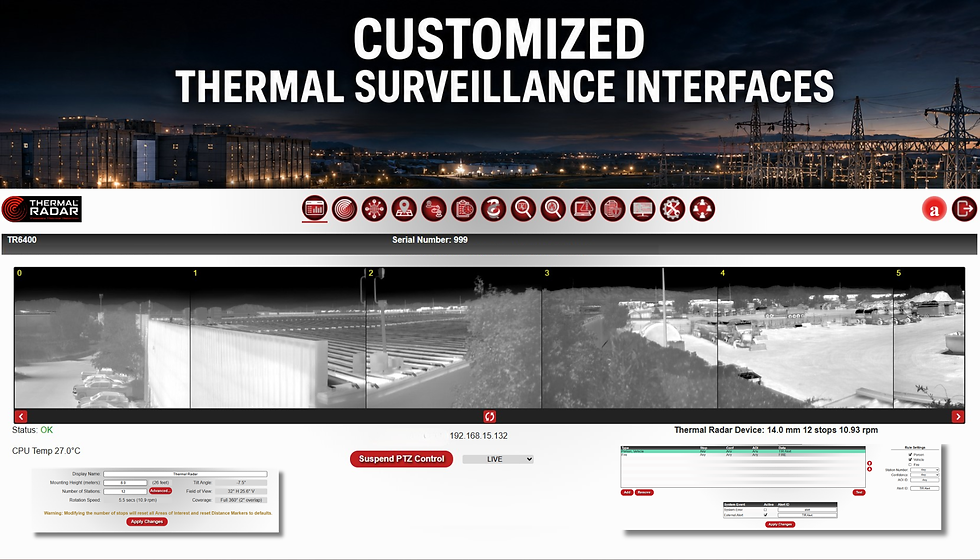
Key Features of a Modern Thermal Surveillance Interface
Geospatial Threat Visualization
One of the most important advancements in thermal surveillance software is the ability to visualize detections on an integrated map or site layout.
Rather than simply displaying a thermal image, advanced systems can show:
Threat location
GPS coordinates
Direction of travel
Distance from protected assets
Historical activity patterns
This level of situational awareness helps security teams make faster and more informed decisions.
Configurable Areas of Interest
Not every section of a facility carries the same level of risk.
Modern thermal surveillance platforms often allow operators to define Areas of Interest and Areas of Exclusion so that alerts are generated only when activity occurs in locations that matter most.
This capability can dramatically reduce nuisance alarms while improving threat prioritization.
Advanced thermal surveillance platforms may even support unlimited user-defined Areas of Interest and customized alerting rules tailored to each deployment environment.
Custom Dashboards and User Roles
Security directors, operators, supervisors, and maintenance personnel all require different information.
Customized interfaces can provide:
Role-based permissions
Site-specific dashboards
Operational summaries
Incident management tools
Reporting views
This improves efficiency while simplifying training and daily operations.
Automated Security Workflows
Today's thermal security systems increasingly automate common security processes.
Examples include:
PTZ camera slew-to-cue actions
Automated notifications
Threat escalation procedures
Incident reporting
Video bookmarking
Multi-sensor coordination
These capabilities help organizations respond more consistently and efficiently to potential threats.
Industries Benefiting from Customized Thermal Surveillance Interfaces
Critical Infrastructure
Critical infrastructure operators face growing pressure to secure assets against both physical threats and operational disruptions.
Customized thermal surveillance interfaces are commonly used to protect:
Electrical substations
Power generation facilities
Water treatment plants
Communications infrastructure
Transportation networks
Data Centers
Data centers require continuous perimeter awareness and rapid threat assessment.
Customized thermal interfaces help operators:
Monitor expansive perimeters
Verify potential threats
Reduce false alarms
Improve situational awareness
Manage multiple facilities from a centralized platform
Solar Farms and Renewable Energy Facilities
Large renewable energy installations often encompass vast geographic areas.
Thermal surveillance platforms can help operators:
Monitor perimeter activity
Track intrusions
Visualize detections geographically
Reduce infrastructure requirements
Improve response coordination
Airports, Ports, and Transportation Facilities
Transportation environments require security systems capable of monitoring large areas while minimizing operational disruptions.
Customized interfaces support:
Restricted area monitoring
Perimeter protection
Asset security
Threat verification
Operational awareness
Military and Border Security Applications
Thermal surveillance has become a critical component of border security and force protection operations because of its ability to detect activity in complete darkness and challenging environmental conditions.
Advanced interfaces further enhance effectiveness through:
Geospatial tracking
Multi-sensor integration
Automated threat visualization
Coordinated response workflows
Deployment Considerations When Selecting a Thermal Surveillance Platform
Before selecting a thermal surveillance solution, organizations should evaluate several key considerations.
Can the Interface Be Customized?
Many systems allow users to configure sensors but provide limited flexibility within the software itself.
Look for platforms that support:
Custom dashboards
User-defined workflows
Site-specific layouts
Configurable alerts
Role-based permissions
Will It Integrate with Existing Systems?
Most organizations already operate multiple security technologies.
A modern thermal surveillance platform should integrate with:
Video Management Systems (VMS)
Access control platforms
PSIM systems
GIS software
Alarm systems
PTZ cameras
Can the Platform Scale?
Security requirements evolve.
The ideal solution should accommodate:
Additional facilities
Additional sensors
Expanded analytics
New operational workflows
Does It Improve Operator Efficiency?
The best thermal surveillance software helps operators identify, assess, and respond to threats faster, not simply display data.
Frequently Asked Questions
Can I Get a Customized Thermal Surveillance Interface in Utah?
Yes. Organizations in Utah have access to providers that offer thermal imaging technologies, surveillance platforms, software development, and security integration services. Utah is also home to Thermal Radar™, a manufacturer of patented 360° thermal surveillance systems headquartered in Orem, Utah.
However, the most important consideration is not where the provider is located. The real question is whether the platform can be customized to support your operational requirements, security objectives, existing infrastructure, and future growth plans.
Modern thermal surveillance deployments often require configurable user interfaces, geospatial awareness, custom alerting workflows, Areas of Interest, integration with existing security systems, and the flexibility to support a wide range of operational environments. The best solutions are designed around the mission rather than the location.
Whether your facility is located in Utah, elsewhere in the United States, or anywhere in the world, organizations should evaluate a provider's ability to customize the platform, integrate with existing infrastructure, and support long-term operational requirements.
What Types of Facilities Benefit Most from Customized Thermal Surveillance Interfaces?
Facilities that commonly benefit include:
Data centers
Utility substations
Solar farms
Airports
Ports
Correctional facilities
Military installations
Oil and gas facilities
Mining operations
Critical infrastructure sites
Why Is Geospatial Awareness Important?
Geospatial awareness allows operators to immediately understand where a threat is located rather than simply observing activity on a camera feed. Advanced systems can display threat locations on integrated maps and provide GPS coordinates for improved response capabilities. Some thermal surveillance platforms provide integrated geo-spatial mapping and location-based alerting as part of the operator interface.
The Future of Customized Thermal Surveillance Interfaces
As artificial intelligence, analytics, and automation continue to advance, thermal surveillance platforms are becoming increasingly intelligent.
Future systems are expected to deliver:
Enhanced threat classification
Automated response recommendations
Predictive analytics
Multi-sensor fusion
Expanded situational awareness
Greater operational automation
Organizations that invest in flexible, customizable platforms today will be better positioned to take advantage of future innovations.
About Thermal Radar™
Thermal Radar™ is a Utah-based manufacturer of patented rotating 360° thermal surveillance systems designed for perimeter security, intrusion detection, fire detection, and critical infrastructure protection. The company develops both its hardware and software platform in-house, enabling organizations to customize user interfaces, Areas of Interest, Areas of Exclusion, alerts, and workflows to meet specific deployment requirements. Thermal Radar™ solutions provide geospatial threat visualization, ONVIF integration, PTZ slew-to-cue functionality, multi-site monitoring capabilities, and continuous 360° situational awareness for large-area security applications.


Comments