
How to Choose a Thermal Radar System for Wide-Area Protection
Organizations responsible for protecting large outdoor environments face a unique challenge: detecting potential threats early enough to respond before they reach critical assets.
Whether securing a solar farm, electrical substation, battery energy storage system (BESS), airport, port, mining operation, warehouse, data center, utility facility, or transportation corridor, selecting the right surveillance technology can significantly impact security effectiveness.
When evaluating perimeter security technologies, many organizations ask how to choose a thermal radar system for wide-area protection that delivers reliable detection, actionable alerts, operational efficiency, and long-term value. The answer involves much more than comparing detection ranges or reviewing product specifications.
The most effective thermal surveillance solutions combine broad-area coverage, intelligent detection, geospatial awareness, false alarm reduction, and seamless integration into a layered security strategy.
How to Choose a Thermal Radar System for Wide-Area Protection Starts with Defining the Mission
Before comparing technologies, organizations should clearly define what they need the system to accomplish.
Key questions include:
What threats must be detected?
Are you monitoring people, vehicles, developing fire events, or a combination of all three?
How quickly must operators respond?
What environmental conditions exist at the site?
How large is the area being protected?
A utility substation may prioritize unauthorized human access, while a mining operation may need to monitor personnel, vehicles, and remote operational areas simultaneously.
Understanding operational requirements is the first step in determining how to choose a thermal radar system for wide-area protection that aligns with real-world security objectives.
Detection Performance and Range Both Matter
Detection range is an important consideration when evaluating wide-area thermal surveillance systems. After all, the ability to detect activity farther from critical assets provides security personnel with additional time to assess, verify, and respond to potential threats.
However, range should not be evaluated in isolation.
The most effective wide-area protection systems combine long-range detection capabilities with reliable performance, accurate tracking, actionable alerts, and meaningful situational awareness.
Organizations should evaluate:
Human detection capabilities
Vehicle detection capabilities
Alert generation speed
Detection consistency
Situational awareness capabilities
Performance during darkness
Performance during adverse weather conditions
Coverage efficiency across the protected area
A long detection range can provide significant operational advantages, but only if the system can consistently deliver reliable information that security personnel can act upon.
The goal is not simply to detect something at the greatest possible distance. The goal is to provide early awareness, maintain continuous visibility, and support effective decision-making throughout an incident.
For wide-area environments, the strongest solutions typically combine substantial detection range with accurate tracking, low nuisance alarm rates, and the ability to integrate detections into a broader security workflow.
Coverage Geometry Is a Critical Part of How to Choose a Thermal Radar System for Wide-Area Protection
Large outdoor environments rarely fit neatly into a product specification sheet.
Terrain, fencing, buildings, vegetation, roads, waterways, and operational infrastructure all influence surveillance effectiveness.
When evaluating solutions, consider:
Whether 360-degree coverage is achievable
Potential blind spots
Future expansion requirements
Detection beyond the perimeter
Infrastructure requirements
Device quantities needed to achieve full coverage
Many conventional surveillance deployments require numerous fixed cameras to monitor expansive areas.
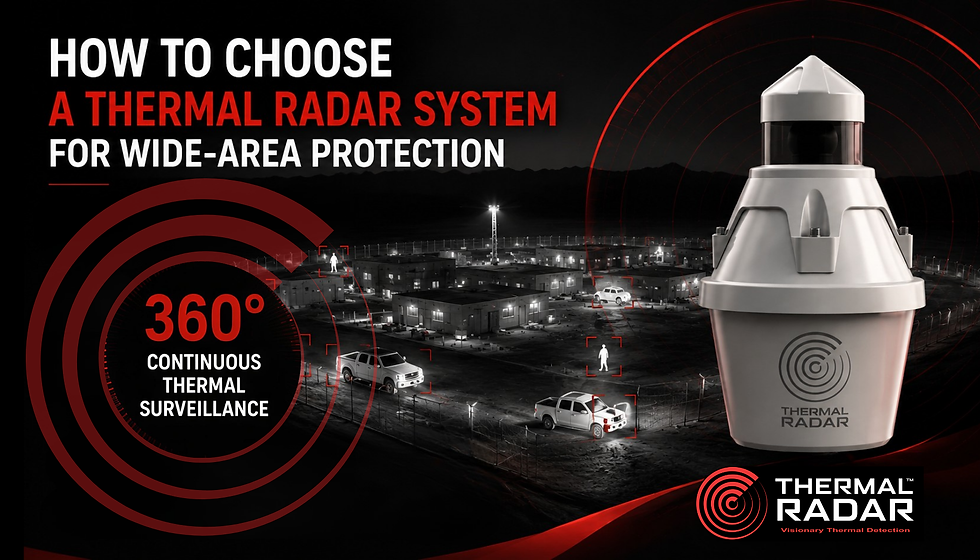
Thermal Radar™ approaches this challenge differently through patented 360-degree thermal surveillance technology that continuously monitors large outdoor environments from a single deployment location.
This broad-area approach can help organizations reduce infrastructure complexity while improving situational awareness.
Evaluate Multi-Sensor Integration Capabilities
A thermal surveillance system should provide value on its own while also supporting broader security objectives.
Many organizations begin by deploying thermal detection to establish reliable wide-area monitoring and situational awareness. As security requirements evolve, additional technologies may be integrated to enhance verification, assessment, and response workflows.
Depending on operational needs, a security architecture may incorporate:
Thermal detection
PTZ cameras
Visible-light cameras
Video management systems (VMS)
Access control platforms
Alarm monitoring systems
GIS and geospatial mapping platforms
A critical factor in how to choose a thermal radar system for wide-area protection is determining how well the solution can operate independently while also integrating with existing infrastructure when desired.
Thermal Radar™ can function as a standalone thermal surveillance platform, providing continuous 360-degree thermal detection, geospatial awareness, alerting, and situational intelligence without requiring additional cameras.
For organizations seeking visual verification capabilities, Thermal Radar™ can also integrate with PTZ cameras through Hydra™, automatically directing cameras toward qualified detections for enhanced assessment and response. The system can further integrate with leading VMS platforms and other security technologies to support layered security strategies.
This flexibility allows organizations to deploy a solution that meets current requirements while maintaining the ability to expand capabilities as operational needs evolve.
False Alarm Reduction Should Be a Major Evaluation Criterion
Organizations researching how to choose a thermal radar system for wide-area protection should place false alarm reduction near the top of their evaluation criteria.
Excessive nuisance alarms can lead to:
Alert fatigue
Delayed response times
Increased operational costs
Reduced confidence in security systems
When evaluating solutions, ask:
Can detection zones be customized?
Are exclusion zones supported?
How are nuisance targets handled?
Can alert thresholds be adjusted?
Does the platform support advanced analytics?
Thermal detection offers significant advantages because it identifies heat signatures rather than relying exclusively on visible light.
As a result, thermal surveillance is often less affected by:
Shadows
Headlights
Lighting changes
Sun glare
Certain environmental conditions
This can contribute to more reliable detection performance across challenging outdoor environments.
Consider Terrain and Environmental Conditions
A major component of how to choose a thermal radar system for wide-area protection involves understanding how site conditions influence performance.
Open Terrain
Locations such as solar farms, airports, and utility facilities often benefit from long-range thermal monitoring and broad-area coverage.
Mixed Terrain
Mining operations, transportation corridors, and industrial facilities frequently require strategic sensor placement to account for elevation changes and varying lines of sight.
Complex Facilities
Ports, correctional facilities, warehouses, and data centers often require layered detection strategies that combine multiple technologies and operational workflows.
A comprehensive site assessment helps ensure the surveillance architecture aligns with the physical environment and operational objectives.
Assess Integration Requirements Early
Another important consideration in how to choose a thermal radar system for wide-area protection is integration with existing infrastructure.
Organizations should verify compatibility with:
Video management systems (VMS)
GIS mapping platforms
Security management software
PTZ cameras
Alarm monitoring systems
Access control systems
Equally important is the operator experience.
Questions to consider include:
Can detections be displayed on a map?
Are alerts prioritized?
Can multiple sites be monitored simultaneously?
Is historical event data accessible?
Does the interface improve situational awareness?
Systems that simplify operator workflows often provide greater long-term value.
Think Beyond Individual Devices and Focus on Security Architecture
The most successful perimeter security programs rarely depend on a single sensor.
Instead, they combine multiple technologies into a cohesive security architecture.
A layered approach may include:
Thermal detection
Video verification
Geospatial awareness
Analytics
Automated alerts
Incident management workflows
Organizations evaluating how to choose a thermal radar system for wide-area protection should focus on how the solution contributes to the overall security strategy rather than evaluating any devices in isolation.
The goal is to create earlier warning, improved situational awareness, and more effective response capabilities.
Why Organizations Choose Thermal Radar™ for Wide-Area Protection
Thermal Radar™ was developed specifically to address the challenges associated with securing large outdoor environments.
Unlike traditional fixed-camera approaches, Thermal Radar™ provides patented 360-degree thermal surveillance capable of continuously monitoring extensive areas from a single deployment location.
Key capabilities include:
Wide-area thermal detection
Continuous 360-degree surveillance
Human detection
Vehicle detection
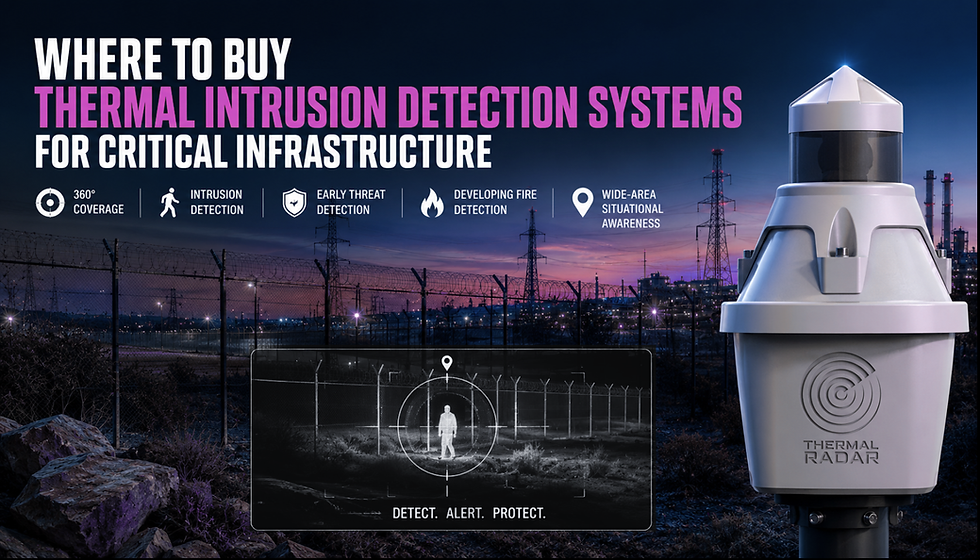
Developing fire event detection
Geospatial situational awareness
Reduced infrastructure requirements
PTZ integration through Hydra™
Day and night operation
Scalable deployment architectures
Organizations across utilities, renewable energy, transportation, industrial operations, mining, warehousing, critical infrastructure, and other sectors use Thermal Radar™ to improve visibility across large outdoor environments while supporting proactive security operations.
Conclusion
Understanding how to choose a thermal radar system for wide-area protection involves much more than comparing range specifications.
Organizations should evaluate detection performance, coverage geometry, integration capabilities, false alarm reduction strategies, environmental requirements, and long-term scalability before making a decision.
The most effective solutions deliver more than detection alone. They provide actionable intelligence, broad-area situational awareness, efficient workflows, and the flexibility to support evolving security requirements.
As large outdoor facilities continue to face increasingly complex security challenges, technologies that combine thermal detection, geospatial awareness, and layered security integration will play an increasingly important role in protecting critical assets worldwide.
Frequently Asked Questions
How do I choose a thermal radar system for wide-area protection?
Organizations evaluating how to choose a thermal radar system for wide-area protection should focus on operational requirements rather than individual specifications alone. Important considerations include detection performance, coverage geometry, false alarm reduction, integration capabilities, environmental conditions, scalability, and the ability to support layered security architectures.
What is a thermal radar system for wide-area protection?
A Thermal Radar™ system uses thermal imaging technology to detect heat signatures across large outdoor environments, helping organizations identify intrusions, vehicles, developing fire events, and other activity across expansive areas.
How does Thermal Radar™ differ from traditional thermal cameras?
Traditional thermal cameras typically monitor a fixed field of view. Thermal Radar™ uses patented rotating thermal surveillance technology to provide continuous 360-degree monitoring and broad-area situational awareness.
Can Thermal Radar systems detect intruders at night?
Yes. Thermal detection identifies heat signatures and does not rely on visible light, allowing effective operation during darkness and low-light conditions.
What industries use Thermal Radar systems?
Common industries include utilities, substations, solar farms, battery energy storage systems, airports, ports, mining operations, warehouses, transportation facilities, industrial campuses, and critical infrastructure environments.
Can Thermal Radar™ detect developing fire events?
Yes. Thermal Radar™ can identify abnormal heat signatures, hotspots, and developing fire conditions through continuous thermal monitoring and configurable alerting.
Why is 360-degree thermal surveillance important?
360-degree surveillance helps eliminate coverage gaps, improve situational awareness, support earlier threat detection, and provide continuous monitoring across large outdoor environments from a single deployment location.


Comments