
Thermal Radar vs. Ground Based Radar for Perimeter Security
Beyond Motion Detection: A New Standard for Perimeter Security

When organizations evaluate Ground Based Radar for Perimeter Security, the goal is simple: detect intrusions early and respond quickly. Ground-based radar is adopted because it can detect motion at long distances and in challenging environments. However, its core limitation is also its defining characteristic: it detects movement, not threats.
Traditional ground-based radar systems were built to answer one question: Did something move? Modern security environments demand more: What is it? Where is it? And does it pose a real threat? That shift is where Thermal Radar fundamentally changes the conversation.
What is Ground Based Radar for Perimeter Security?
Ground-based radar for perimeter security is a widely used technology designed to detect movement across large outdoor areas. These systems operate using active radio frequency (RF) transmission, meaning they continuously emit radio waves and analyze how those waves reflect off objects in the environment. When something moves within the radar’s field of view, the system detects a change in the reflected signal and generates an alert.
This approach makes radar highly effective at identifying motion at long distances, even in low visibility conditions such as darkness, fog, or dust. For this reason, ground-based radar has become a common choice for securing large perimeters like industrial sites, utilities, and critical infrastructure.
However, it’s important to understand what radar is actually detecting. At its core, radar is not identifying a person, vehicle, or specific threat. It is identifying movement within a defined coverage area. That distinction plays a major role in how these systems are deployed and how operators interact with them.
Key Characteristics of Ground-Based Radar
Emits radio waves and detects reflected signals
Operates in sector-based coverage (commonly ~90° to 120° per radar)
Detects movement of objects at a distance
Provides range and speed, but not visual identity
Offers motion awareness, not full threat context
Requires multiple radars for full 360° coverage
Commonly integrated with PTZ cameras for verification
Because each radar unit only monitors a portion of the environment, securing an entire site requires combining multiple sensors. These systems are typically arranged around the perimeter to create continuous coverage.
In real-world deployments, this leads to a layered setup where radars, cameras, and software all work together to provide usable information to operators. As a result, most radar-based deployments require:
Multiple radar units positioned around the site
Overlapping coverage zones to reduce potential gaps
Integration with PTZ cameras for visual verification
This architecture can be effective, but it also introduces additional complexity. Instead of a single system providing complete awareness, operators often rely on multiple devices working together to interpret what is happening across the perimeter.
The Core Limitation: Motion ≠ Threat
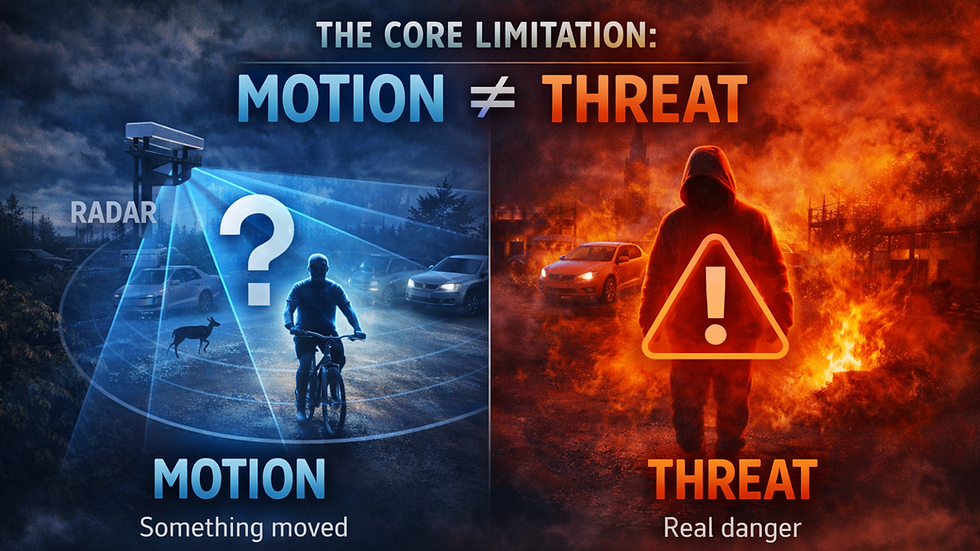
One of the most important distinctions to understand when evaluating ground-based radar for perimeter security is this: detection of motion is not the same as detection of a threat.
Radar systems are designed to identify movement within a defined area. When that movement occurs, the system generates an alert based on changes in reflected RF signals. While this is highly effective for knowing that something is happening, it does not provide the level of context needed to determine whether that activity actually represents a risk.
In practice, this means operators are often responding to alerts without knowing what triggered them. A radar notification might indicate movement at a specific distance and direction, but it does not inherently explain the nature of the object or its relevance. As a result, additional systems and steps are required to interpret what the alert actually means.
A radar alert tells you something moved, but it does not tell you:
If it is a person or a vehicle
If it is relevant activity or environmental noise
If the situation is escalating into a real risk
If there is a fire or thermal-related event
This lack of context creates a gap between detection and decision-making. Operators are not just asking, “Did something move?” They are asking, “Does this matter?” and “Do I need to act right now?”
Without immediate answers to those questions, teams must rely on additional verification steps, which can slow down response and increase operational burden. This often leads to real-world challenges such as:
Higher false alarm rates due to non-threatening motion
Delayed response times while verifying alerts
Dependence on camera systems for visual confirmation
In many deployments, radar becomes the first trigger in a multi-step process, rather than a complete solution. It detects motion, then hands off to other systems to determine what that motion actually represents. That distinction is critical because, in perimeter security, speed and certainty matter just as much as detection itself.
Thermal Radar: Moving from Motion Awareness to Threat Awareness
Thermal Radar takes a fundamentally different approach to perimeter security. Instead of relying on active RF transmission to detect movement, Thermal Radar uses passive thermal imaging to continuously observe heat signatures across an entire environment. This means the system is not just reacting to motion; it is interpreting what is actually present within the scene.
That distinction changes everything. Where ground-based radar answers the question, “Did something move?”, Thermal Radar is designed to answer, “What is happening?”
The Result is a Transition from Motion Awareness to Threat Awareness
By analyzing thermal signatures in real time, Thermal Radar can differentiate between types of objects and conditions within its field of view. Instead of generating alerts based solely on movement, it provides context around the nature of the detection itself. This allows operators to make faster, more informed decisions without needing to immediately rely on secondary systems for interpretation.
Thermal Radar provides:
Continuous 360° coverage from a single sensor
Detection of humans, vehicles, and fire events
Passive operation with no RF emissions
Built-in visual context without requiring PTZ verification (optional PTZ integration is available through *Hydra for additional identification and zoomed-in assessment
Because the system delivers both detection and context simultaneously, it reduces the gap between alert and action. In real-world deployments, this means fewer steps, fewer dependencies, and a clearer understanding of what is occurring across the perimeter the moment an event is detected.
Key Differences: Thermal Radar vs. Ground Based Radar for Perimeter Security
Why This Matters for Real-World Security
Perimeter security does not exist in a vacuum. It operates in environments where the stakes are high, response time matters, and every alert has operational consequences. Security teams are not simply watching for movement. They are responsible for protecting assets, maintaining uptime, and preventing incidents before they escalate into costly or dangerous events. In many cases, they are managing large, complex environments where a single missed alert or delayed response can have a significant impact.
In the real world, security teams are responsible for:
Protecting critical infrastructure
Preventing theft, intrusion, and unauthorized access
Detecting fire risks as early as possible
Reducing false alarms that drain time and resources
This is where the difference between motion awareness and threat awareness becomes operationally significant. When systems generate alerts based only on movement, teams are forced into a reactive posture. They must investigate, verify, and interpret each alert before deciding whether action is required. Over time, this can lead to alert fatigue, slower response times, and reduced confidence in the system.
Thermal Radar changes that dynamic by providing context at the moment of detection. Instead of requiring multiple systems and steps to understand what is happening, it delivers a clearer picture upfront. This allows teams to move from questioning alerts to acting on them with confidence.
Thermal Radar delivers true threat awareness:
Identifies the threat, not just the movement
Pinpoints exact location with geospatial precision
Measures heat signatures to reveal potential risk
Detects fires early, before they escalate
Provides full-site awareness rather than fragmented coverage
The result is a more efficient security operation. Fewer false alarms mean less time wasted. Faster understanding means quicker response. Greater visibility across the entire site means fewer blind spots where issues can go unnoticed. In environments where both security and safety are priorities, that level of awareness is not just beneficial; it is essential.
Why Fire Detection Changes Everything
One of the most important differences between these technologies is also one of the most overlooked:
👉 Ground radar is not designed to detect fire
👉 Thermal Radar can detect temperature anomalies early

Ground-based radar systems are built to detect motion. If something is not moving, it typically does not trigger an alert. That means risks that develop without movement, such as early-stage fire conditions, can go unnoticed until they become visible or cause secondary effects.
Thermal Radar operates differently because it is measuring heat, not motion. This allows it to detect changes in temperature that may indicate a developing issue, even before flames are visible or damage has occurred. In many environments, that early awareness can be the difference between a manageable event and a major incident.
This capability is especially critical in environments such as:
Utilities and electrical substations
Battery energy storage systems (BESS)
Oil and gas facilities
Remote or unmanned industrial sites
In these types of deployments, fire risk is not always tied to visible activity. Thermal conditions can escalate without any movement at all. Because radar is not designed to detect these conditions, it plays no role in early fire identification.
Thermal Radar, on the other hand, can identify temperature anomalies at the earliest stages, enabling teams to respond before a situation escalates into open flame or safety hazard. Early detection does not just improve response time; it can:
Reduce damage to critical infrastructure
Prevent operational downtime
Improve overall site safety
In environments where both security and safety are priorities, the ability to detect fire risk early is not just an added feature; it is a fundamental advantage.
The Bottom Line: Motion vs Threat Awareness
When comparing ground-based radar for perimeter security to Thermal Radar, the difference is not incremental. It is architectural. These two approaches are built on fundamentally different detection models, and that difference directly impacts how security teams operate, how quickly they can respond, and how much infrastructure is required to support the system.
Ground-based radar systems are designed around motion detection. They are effective at identifying activity across large areas, but they rely on additional systems and workflows to determine what that activity actually represents. As a result, they tend to operate within a multi-layered, reactive framework, where detection is only the first step in a longer process.
Thermal Radar shifts that model by delivering context at the point of detection. Instead of identifying movement and handing off to other systems for interpretation, it provides immediate insight into what is happening across the site. This enables a more streamlined, efficient, and proactive approach to perimeter security.
Ground Radar:
Motion-based awareness
Multi-device architecture
Detection-first, interpretation-second workflow
Dependent on additional systems for context
Reactive response model
Thermal Radar:
Heat-based threat awareness
Single-sensor coverage across large areas
Provides context at the moment of detection
Enables faster, more informed response
Supports a proactive operational workflow
In practical terms, this means security teams using ground-based radar are often asking, “What just triggered that alert?”, while teams using Thermal Radar are able to focus on “What action should we take?” That shift from interpretation to action ultimately defines the difference between motion awareness and true threat awareness.
Final Takeaway and Conclusion
When evaluating Ground Based Radar for Perimeter Security, the most important question is not which technology detects the farthest or covers the most ground. The real question is: What problem are you trying to solve?
If the objective is simply to detect movement across a perimeter, ground-based radar can be an effective solution. It provides long-range awareness and can alert operators when activity occurs within a defined area.
👉 Detect movement → Radar works
But modern security environments require more than awareness of motion. They require clarity, context, and the ability to respond quickly and confidently. If the objective is to understand what is happening and take action without delay, then detection alone is not enough.
👉 Understand and respond to threats → You need more
This is where Thermal Radar delivers a fundamentally different level of capability.
Thermal Radar provides:
Continuous 360° awareness across the entire site
Built-in classification of humans, vehicles, and thermal events
Early fire detection through temperature anomaly identification
Reduced system complexity with fewer devices and dependencies
The result is a system that not only detects activity but helps operators immediately understand what that activity means.
Perimeter Security is Evolving
It is no longer just about detecting that something happened. It is about understanding what matters and responding before it escalates.
Detect Heat.
Locate Threats.
Respond Faster.
If you’re exploring options for Ground Based Radar for Perimeter Security and want a deeper comparison, including side-by-side analysis and deployment considerations:
Contact Us Today to schedule a demo of Thermal Radar™!


#TheThermalRadarDifference